
www.magazine-industry-usa.com
19
'26
Written on Modified on
Rethinking large motor design for high-demand applications
Wolong Electric America outlines how higher speeds, tighter footprints, and integrated digital validation are reshaping large industrial motor engineering.
www.wolongamerica.com
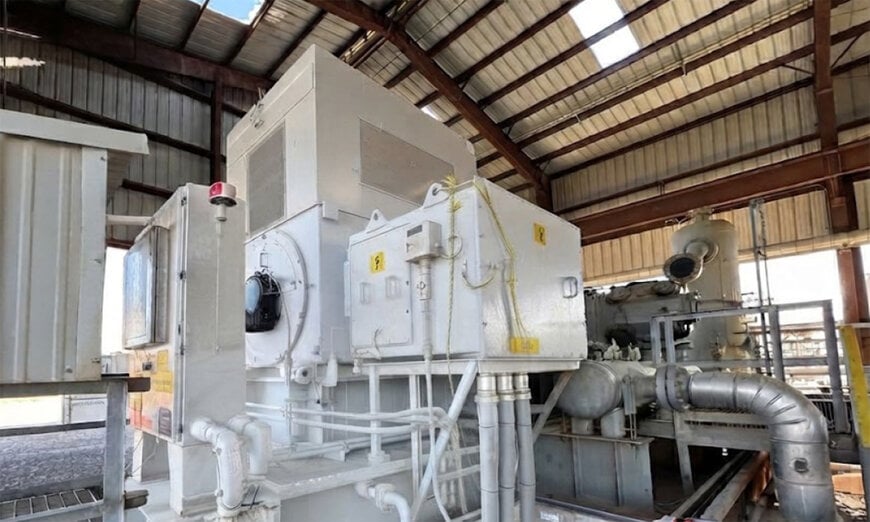
By Valmir Andrade, Product Manager at Wolong Electric America
For a large industrial motor, increasing horsepower is rarely as simple as scaling everything up. More power generally means more heat to remove. Higher rotational speeds place greater demands on rotor dynamics and vibration control. A larger frame may even interfere with an existing foundation, piping, or driven equipment, and in facilities where nearly every available foot has already been claimed by pumps, compressors, coolers, electrical equipment, and process infrastructure, simply making the motor bigger may not be a practical option.
These pressures are becoming more pronounced as industrial investment moves toward applications requiring substantial power in constrained environments. Petrochemical, oil and gas, LNG and pipeline facilities remain prominent examples, particularly where large pumps and compressors operate continuously. Similar challenges are appearing in power generation and in the cooling-water infrastructure that supports large data centres. Mining creates a different version of the problem: rather than prioritising high speed, many applications require lower-speed motors capable of producing substantial torque.
The common requirement is therefore broader than horsepower. Users increasingly need large motors capable of delivering the required mechanical output while fitting the physical, electrical, thermal, and operational realities of the equipment around them.
Balancing power density, speed, and thermal management
One way manufacturers can deliver more power without simply building a larger motor is by increasing power density, which means getting more useful output from a given physical footprint. For some applications, higher operating speeds are part of that equation. A motor operating closer to 3,600 rpm, for example, can deliver substantial power in a more compact package than some lower-speed alternatives. That can be a real advantage in petrochemical plants, pipeline facilities, and other process environments where pumps, piping, coolers, and structural equipment are already competing for space. A smaller motor package can make equipment layout easier and, in some cases, reduce the amount of surrounding infrastructure that has to change.
The trade-off is that packing more power and speed into a smaller space puts greater demands on the motor itself. Rotor dynamics are one of the first considerations. Every rotating structure has natural frequencies, and engineers have to make sure the motor's operating speeds do not interact with those frequencies in a way that creates resonance. As rotational speed increases, vibration can become more difficult to manage, increasing the potential load on bearings and other mechanical components.
More power in a compact frame also means more heat has to be managed within that same limited space. Electrical and mechanical losses generate heat during operation, so the cooling system has to be designed alongside the motor rather than added as an afterthought. Depending on the application, that may mean carefully engineered air circulation or a water-cooled system capable of carrying heat away from critical internal components.
These mechanical and thermal considerations ultimately become part of the specification process. In industries such as petrochemical processing and oil and gas, project requirements and American industry standards, including API 541, where applicable, can define expectations for rotor behaviour, vibration, cooling, and other critical-to-quality characteristics. Horsepower still matters, but it is only one piece of the selection process. The motor also has to deliver that power at the required speed, within the available footprint, and without compromising the reliability the application demands.
Designing the motor around the application
Power and speed are only part of the fit. The physical constraints of the installation can be just as important when engineers are specifying a large motor. Many traditional motor families are built around predetermined frame sizes and configurations. That works when the application falls comfortably within those options. The challenge comes when the motor has to fit into an existing facility and satisfy a specification written around equipment that is already in place.
A new unit might provide exactly the right horsepower and operating speed, but if the shaft height, mounting dimensions, enclosure, or overall length are different, the project can quickly expand beyond the motor itself. Foundations may need to change. Connected equipment may need to move. What initially looked like a straightforward replacement can become a much larger mechanical installation.
A more configurable motor platform gives engineers another option: design the motor around the application rather than redesigning the application around the motor. Depending on the project, engineers can adjust elements such as the frame, shaft arrangement, cooling method, voltage, speed, starting method, protection, and monitoring features to better match the driven equipment and the available space.
That flexibility can be particularly valuable in retrofit projects, where minimising changes to the surrounding equipment can simplify installation. That flexibility comes with an engineering responsibility. Changes to the frame, shaft arrangement, cooling system, or other features can affect how the motor performs, so each configuration has to be evaluated to make sure those adjustments do not introduce problems with heat, vibration, or reliability.
Digital validation and integrated system modelling
Engineering validation becomes especially important as motor designs become more configurable. Before a customised configuration reaches the field, engineers need to understand how changes to the motor's geometry, cooling system, and other design features will affect its performance. Modern simulation tools allow much of that evaluation to happen before physical components are manufactured. Computational fluid dynamics, or CFD, can model how cooling air moves through the motor, including its direction, pressure, and velocity as it passes around heat-generating components. Engineers can then compare different internal geometries and airflow paths to determine which arrangement removes heat most effectively.
Mechanical behaviour requires a different kind of analysis. Finite element analysis can help engineers understand how the motor structure responds under operating conditions and identify areas where resonance or excessive vibration could become a concern. Instead of waiting for a completed prototype to reveal a problem, the design can be adjusted and simulated again while it still exists primarily as a digital model. Although digital modeling has eliminated the need for repeated, iterative prototyping, testing still matters. The advantage of simulation is that engineers can arrive at the prototyping stage with a much more mature design.
That more mature prototype is only possible when the motor is evaluated as an integrated system rather than as a collection of independent features. An effective motor solution for these increasingly demanding applications must address several interdependent requirements.
Higher output within a constrained footprint requires that increased power density be achieved without compromising thermal margin, structural integrity, or dynamic stability.
Suitability for variable-speed operation demands that insulation stress, transient voltage, shaft voltage, bearing currents, and cooling performance be evaluated across the specified speed range.
Configuration around the application ensures that speed, enclosure, cooling arrangement, and mechanical interfaces reflect the requirements of the driven equipment and the installation.
Adaptation to actual operating conditions means that ambient temperature, altitude, load profile, starting duty, and system inertia must be incorporated into the design basis.
Integrated monitoring provisions require that winding temperature, bearing temperature, and vibration monitoring be selected according to the criticality and operating profile of the driven system.
The modelling and validation methodology applied by Wolong in the development of Quantum Infinity reflects this integrated design philosophy. Electromagnetic, thermal, and mechanical parameters are evaluated within a common analytical framework, allowing their interactions to be examined before an individual configuration advances to fabrication and full-scale testing. This approach established the technical foundation for a large-motor architecture extending to ratings up to 10,000 hp, while providing the design latitude required to configure individual motors around the application.
That broader design envelope enables the same underlying architecture to address markedly different operating requirements. High-speed configurations, for example, may be applied to pumping systems used in pipelines or data-centre cooling infrastructure. At the other end of the operating spectrum, mining and other heavy-duty applications may require lower speeds and substantially higher torque. These are not simply variations in motor rating. Each imposes a distinct combination of electromagnetic, thermal, mechanical, and dynamic requirements.
The significance of a configurable platform therefore lies not in the number of arrangements it can offer, but in the ability to develop and validate those arrangements within a consistent engineering framework. As large-motor applications continue to demand greater output, broader operating ranges, and closer integration with the driven equipment, the ability to correlate analytical predictions with measured performance will become increasingly important. Ultimately, the value of advanced modelling is realised when it produces a motor configuration that is not merely compliant with a specification, but technically aligned with the operating conditions of the complete system.
Aligning complex specifications with project execution
Large industrial specifications can run hundreds of pages, and length does not necessarily mean every requirement is clear. Different sections may have been written by different teams or carried forward from earlier projects, which can create conflicting instructions. One part of the specification might call for a particular monitoring device, for example, while another suggests that the same accessory is unnecessary.
A manufacturer could simply follow every requirement as written, but that is not always the best outcome. Unnecessary features can add cost and complexity, while unresolved contradictions can result in a motor that technically meets the document but does not align as closely as it could with the real operating conditions.
That makes application engineering an important part of the selection process. For Quantum Infinity, Wolong has dedicated application engineers who can review specifications with OEMs and engineering firms, identify unclear or conflicting requirements, and help determine which configuration makes the most sense for the project. Once an order moves forward, project management resources remain involved through production, while customers can also visit the manufacturing operation and witness final testing.
A large motor is rarely an isolated purchase; it is usually one component within a much larger system involving pumps, compressors, electrical equipment, piping, controls, and construction schedules. OEMs and engineering firms therefore have to consider more than whether the motor meets its technical requirements. Lead time, project scheduling, cost, and the manufacturer's ability to respond when questions arise can all affect the success of the larger project.
That broader project context is becoming more important as customers invest in larger, more power-dense equipment for data centres, energy infrastructure, LNG facilities, pipelines, and other critical applications. "Quantum Infinity gives us the ability to provide application-engineered solutions up to 10,000 horsepower while offering the responsiveness, competitive lead times, and North American engineering support our customers expect," says Jim Kvas, President of Wolong Electric America.
In that context, reliability extends beyond the motor itself. A technically capable product can still create problems if specification questions linger, production milestones are unclear, or unexpected installation issues surface late in the project. Strong application and project support help reduce those uncertainties before they reach the field.
That same need for adaptability is also shaping where configurable motor platforms go next. Quantum Infinity initially focuses on horizontal motors, which Wolong estimates account for the majority of current U.S. demand. The company plans to extend the platform into vertical configurations as well, allowing the same design approach to address applications where the driven equipment requires a different orientation.
The broader direction is clear. Large industrial applications are becoming more varied while expectations for power density, efficiency, reliability, and equipment fit are increasing. One project may prioritise high speed and a compact footprint; another may need lower speed and much greater torque. Cooling methods, shaft arrangements, monitoring requirements, and installation constraints can change again from site to site.
Large motor design is increasingly a balancing act between power density, flexibility, thermal performance, and mechanical reliability. The strongest designs will be the ones that push those limits together, not advancing one at the expense of the others.
Additional Context:
This section explains general principles not included in the original article.
In electric motor physics, mechanical power output is proportional to the product of rotational speed and torque. Consequently, achieving high horsepower at low rotational speeds—as required in heavy mining crushers or conveyors—demands substantially higher magnetic flux and larger rotor diameters to generate the necessary twisting force. Conversely, operating at higher speeds allows a smaller rotor to deliver the same mechanical power, though this introduces heightened centrifugal forces and requires precise balancing to prevent critical speed resonance.
When large motors are driven by Variable Frequency Drives (VFDs) to modulate speed, the fast-switching voltage pulses can induce parasitic high-frequency voltages along the motor shaft. If these voltages exceed the dielectric breakdown threshold of the bearing lubricant film, electrical current discharges across the bearing raceways—a phenomenon known as Electrical Discharge Machining (EDM) or bearing currents—which causes microscopic pitting and premature mechanical failure unless mitigated through insulated bearings or shaft grounding systems.
Edited by an industrial journalist, Lekshman Ramdas, with AI assistance.
www.wolong-electric.com
