
www.magazine-industry-usa.com
09
'26
Written on Modified on
Caracol Brings Robotic Microfactory Manufacturing Model to IMTS 2026
HERON 300 HV combines robotic additive manufacturing, CNC machining, automation and AI to support distributed production of large industrial parts domestically.
www.caracol-am.com
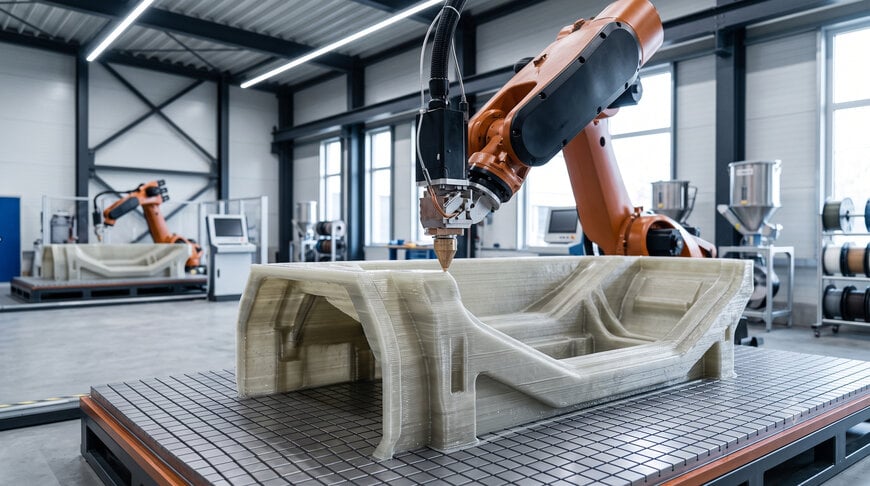
AI Generated Image
Caracol is demonstrating its robotic large-format additive manufacturing microfactory architecture at the International Manufacturing Technology Show in Chicago. This distributed production model utilizes robotics and artificial intelligence to manufacture metal and composite components for aerospace, marine, and energy applications directly at the point of need.
Distributed Microfactory Production Operations
The centralization of industrial manufacturing has introduced supply chain fragility and increased the distance between production facilities and component end-users. The microfactory model addresses these limitations by deploying reconfigurable production plants capable of executing multiple operations locally. Within this architecture, advanced robotics, automation, and artificial intelligence operate concurrently to provide distributed capacity. This framework allows for the production of components such as satellite tanks, ship propellers, oil and gas neck flanges, carbon fiber motorsport molds, and freeform three-dimensional bars as single, tooling-free builds directly where the parts are required. Francesco De Stefano, co-founder and chief executive officer of Caracol, noted that distributed production powered by robotics and automation brings capacity close to the point of use with the repeatability required for industrial applications.
Robotic Large-Format Additive Manufacturing Architecture
To demonstrate the capabilities of this technology, Caracol is exhibiting its hardware at the International Manufacturing Technology Show, scheduled for September 14 to 19, 2026, at McCormick Place in Chicago, within the North Hall at Booth 237020. The exhibition features live, real-time automated large-format additive manufacturing deposition, illustrating the precision and quality consistency of the robotic process. South Carolina-based Freeman Boatworks has adopted the Caracol HERON 300 HV system in a hybrid configuration, which integrates continuous material extrusion with post-process computer numerical control machining. By combining additive manufacturing with subtractive finishing, Freeman Boatworks intends to produce large-scale tooling and composite parts in-house, reducing overall lead times and enabling complex geometries that surpass the limitations of conventional molding methods.
North American Industrial Market Integration
To further integrate into the domestic supply chain, Caracol has established membership with America Makes, the national additive manufacturing innovation institute functioning under the Manufacturing USA network. This collaboration integrates the company into a consortium of government and academic entities developing technology roadmaps and scaling supply chains for advanced manufacturing. By operating through its Austin, Texas facility, the company aims to establish robotic large-format additive manufacturing as a mainstream production method across the North American industrial sector.
Additional Context:
This section details technical specifications and competitive benchmarking not included in the original product announcement
Within the robotic large-format additive manufacturing market, the Caracol HERON 300 HV system competes with hybrid production platforms such as the CEAD Flexbot and the Thermwood LSAM line. The HERON 300 HV utilizes a six-axis robotic kinematic architecture paired with a high-flow pellet extruder to process fiber-reinforced thermoplastic matrixes, including carbon-fiber acrylonitrile butadiene styrene and glass-fiber polypropylene. This near-net-shape deposition is coupled with integrated computer numerical control milling to achieve dimensional tolerances of 0.2 millimeters and surface roughness values of 1.2 micrometers. While gantry-based systems like the Thermwood LSAM typically provide larger continuous build volumes for aerospace tooling, six-axis robotic platforms such as those from Caracol and CEAD offer superior flexibility for complex geometries and allow for continuous out-of-plane extrusion without the requirement for localized support structures.
Edited by Natania Lyngdoh, Induportals editor, assisted by AI.
www.caracol-am.com
Caracol is demonstrating its robotic large-format additive manufacturing microfactory architecture at the International Manufacturing Technology Show in Chicago. This distributed production model utilizes robotics and artificial intelligence to manufacture metal and composite components for aerospace, marine, and energy applications directly at the point of need.
Distributed Microfactory Production Operations
The centralization of industrial manufacturing has introduced supply chain fragility and increased the distance between production facilities and component end-users. The microfactory model addresses these limitations by deploying reconfigurable production plants capable of executing multiple operations locally. Within this architecture, advanced robotics, automation, and artificial intelligence operate concurrently to provide distributed capacity. This framework allows for the production of components such as satellite tanks, ship propellers, oil and gas neck flanges, carbon fiber motorsport molds, and freeform three-dimensional bars as single, tooling-free builds directly where the parts are required. Francesco De Stefano, co-founder and chief executive officer of Caracol, noted that distributed production powered by robotics and automation brings capacity close to the point of use with the repeatability required for industrial applications.
Robotic Large-Format Additive Manufacturing Architecture
To demonstrate the capabilities of this technology, Caracol is exhibiting its hardware at the International Manufacturing Technology Show, scheduled for September 14 to 19, 2026, at McCormick Place in Chicago, within the North Hall at Booth 237020. The exhibition features live, real-time automated large-format additive manufacturing deposition, illustrating the precision and quality consistency of the robotic process. South Carolina-based Freeman Boatworks has adopted the Caracol HERON 300 HV system in a hybrid configuration, which integrates continuous material extrusion with post-process computer numerical control machining. By combining additive manufacturing with subtractive finishing, Freeman Boatworks intends to produce large-scale tooling and composite parts in-house, reducing overall lead times and enabling complex geometries that surpass the limitations of conventional molding methods.
North American Industrial Market Integration
To further integrate into the domestic supply chain, Caracol has established membership with America Makes, the national additive manufacturing innovation institute functioning under the Manufacturing USA network. This collaboration integrates the company into a consortium of government and academic entities developing technology roadmaps and scaling supply chains for advanced manufacturing. By operating through its Austin, Texas facility, the company aims to establish robotic large-format additive manufacturing as a mainstream production method across the North American industrial sector.
Additional Context:
This section details technical specifications and competitive benchmarking not included in the original product announcement
Within the robotic large-format additive manufacturing market, the Caracol HERON 300 HV system competes with hybrid production platforms such as the CEAD Flexbot and the Thermwood LSAM line. The HERON 300 HV utilizes a six-axis robotic kinematic architecture paired with a high-flow pellet extruder to process fiber-reinforced thermoplastic matrixes, including carbon-fiber acrylonitrile butadiene styrene and glass-fiber polypropylene. This near-net-shape deposition is coupled with integrated computer numerical control milling to achieve dimensional tolerances of 0.2 millimeters and surface roughness values of 1.2 micrometers. While gantry-based systems like the Thermwood LSAM typically provide larger continuous build volumes for aerospace tooling, six-axis robotic platforms such as those from Caracol and CEAD offer superior flexibility for complex geometries and allow for continuous out-of-plane extrusion without the requirement for localized support structures.
Edited by Natania Lyngdoh, Induportals editor, assisted by AI.
www.caracol-am.com
-2296-71282-204124.png)