
www.magazine-industry-usa.com
23
'26
Written on Modified on
AMD Powers the Next Chapter of American Science
Powered by AMD, the Lux and Discovery supercomputers will advance the Genesis Mission by connecting high-performance computing, AI and scientific data across critical US research.
www.amd.com
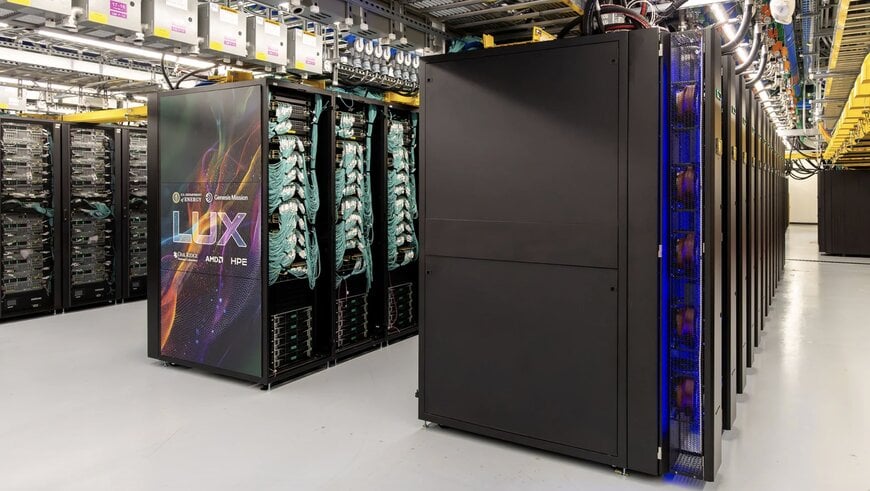
AMD technologies are powering the Lux and Discovery supercomputers to support the U.S. Department of Energy’s Genesis Mission across high-performance computing, artificial intelligence, and scientific data applications.
Lux System Deployment and Hardware Architecture
Lux is scheduled to become the first operational computing platform under the Genesis Mission, with an expected deployment start in October 2026. Powered by AMD hardware, the platform is designed to expand the U.S. Department of Energy’s (DOE) AI research capabilities across energy research, materials science, medicine, and advanced manufacturing. The hardware architecture combines AMD Instinct MI355X GPUs, AMD EPYC CPUs, AMD Pensando networking hardware, and an open software ecosystem.
The platform integrates traditional high-performance computing (HPC) software with cloud-native AI tools to process end-to-end scientific workflows from data collection to analysis. Lux is engineered to support the American Science Cloud, collaborative model development, autonomous research laboratories, digital twin deployments, persistent AI services, and future multi-processor computing architectures spanning CPUs, GPUs, and quantum processors.
Discovery Platform and Long-Term Converged Infrastructure
Following Lux, the Discovery supercomputer is planned as a next-generation exascale system deployed through a collaboration involving the DOE, Oak Ridge National Laboratory, and HPE. The system is designed to operate as a long-term platform for converged high-performance computing and artificial intelligence.
Discovery will incorporate 6th Gen AMD EPYC processors, AMD Instinct MI430X GPUs, AMD Pensando networking, and the open ROCm software stack. Featuring native FP64 precision support, the system is engineered to handle high-accuracy scientific simulations, AI modeling, and data analytics across mission-critical research initiatives.
Scientific Impact and Frontier Benchmark Workflows
The computational convergence model deployed in Lux and Discovery draws on computational workflows previously demonstrated by the AMD-powered Frontier supercomputer. On Frontier, researchers reduced plant-imaging analysis times from 168 hours to under one minute. Additionally, researchers utilize the system to analyze materials for producing tritium fuel in future fusion reactors.
These implementations demonstrate the compute workflows intended for Lux and Discovery, supporting research in critical mineral recovery, fusion energy platforms, hydropower infrastructure, flood response modeling, and electrical grid resilience.
Genesis Mission Integration Framework
The Genesis Mission brings together U.S. Department of Energy national laboratories, industrial partners, and academic institutions to apply artificial intelligence across energy research, foundational science, and national security. The integrated research platform is structured to shorten discovery cycles and increase research productivity by enabling scientific models, instrument workflows, and data processing routines to transition into AI-driven insights.
Additional Context
This section details technical specifications not included in the original news release.
Exascale supercomputing and AI convergence rely on high-bandwidth memory architectures and specialized interconnect topologies to process large-scale scientific models without memory bottlenecks. In hardware platforms powering these systems, high-density accelerators utilize high-bandwidth memory (such as HBM3E and HBM4) delivering multi-terabyte-per-second memory bandwidth to support multi-billion and trillion-parameter artificial intelligence models alongside full-precision FP64 double-precision matrix and vector calculations.
Data routing across distributed compute nodes is managed by Data Processing Units (DPUs) and specialized SmartNICs, which offload packet processing, network virtualization, and security telemetry directly from the host CPU. On the software layer, the open-source ROCm (Radeon Open Compute) framework provides a runtime environment and API stack compliant with standard parallel programming paradigms, including HIP, OpenMP, and MPI. This architecture enables scientific software codes developed for C++ and Fortran environments to execute across heterogeneous CPU, GPU, and specialized accelerator nodes without proprietary driver lock-in.
Edited by Romila DSilva, Induportals Editor, with AI assistance.
www.amd.com
