
www.magazine-industry-usa.com
10
'26
Written on Modified on
Unified AC/DC Electrical Protection for Power Systems
Mersen has engineered a single-component architecture that combines alternating and direct current protection to streamline circuit design within the digital supply chain.
www.mersen.com
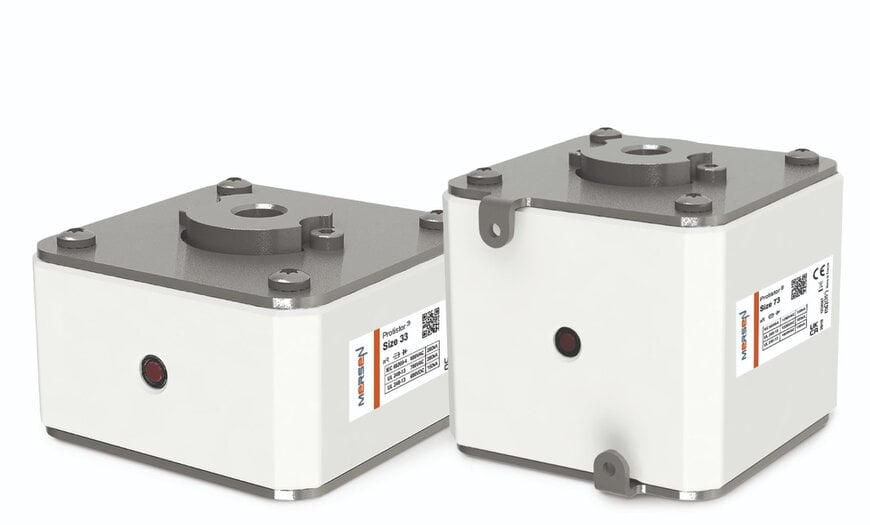
Photo: Mersen
Mersen has launched a new generation of high-performance fuses designed to provide unified AC and DC electrical protection across renewable energy, energy storage, data center, and electric vehicle charging infrastructures. These systems consolidate dual-current protection capabilities into a single, compact component to optimize performance in power electronics applications such as inverters, solid-state transformers, charging stations, and megawatt charging systems.
Dual-Current Circuit Protection
Historically, power conversion equipment manufacturers required separate, dedicated fuse types to manage alternating current (AC) and direct current (DC) circuits. This new product range eliminates the dual-component requirement by merging these distinct electrical characteristics into a single housing. Operating as standard AC, aR (partial range semiconductor), or fast-acting fuses, the units reduce physical space requirements within equipment enclosures. This consolidation also simplifies procurement workflows within the automotive data ecosystem by reducing the total number of distinct stock-keeping units required for system assembly.
Power Electronics Standardization
Designed for environments converting direct current from photovoltaic and wind energy plants into grid-compatible alternating current, the fuses address emerging high-power demands with two new sizes rated up to 1000 V and 1000 A. To ensure compliance across global markets, production is executed on fully automated assembly lines adhering to IEC, UL, CCC, RoHS, REACH, and WEEE standards.
Validation is supported by quality testing conducted within the manufacturer’s UL-recognized test laboratory and independent external institutes. To assist engineering design phases, simulation data is provided to model specific fuse behavior under custom application parameters, ensuring precise component selection based on thermal and electrical loads. The technology was showcased at the PCIM 2026 trade exposition in Nuremberg, Germany, from June 9 to June 11, 2026.
Additional Context
This section details technical specifications and competitive benchmarking not included in the original news release.
In the power electronics sector, circuit protection at the 1000 V / 1000 A threshold requires managing intense thermal dissipation and high breaking capacities. Traditional semiconductor fuses from competitors like Eaton (Bussmann series) or Littelfuse typically bifurcate their high-speed portfolios into distinct AC (e.g., square body) and DC (e.g., cylindrical photovoltaic or EV series) architectures due to the differing physics of arc interruption between the two current types.
By utilizing advanced filling materials and optimized element geometries, hybrid AC/DC fuses achieve the rapid clearing times (I2t let-through energy minimization) required to protect sensitive insulated-gate bipolar transistors (IGBTs) and silicon carbide (SiC) MOSFETs, while maintaining a high DC interrupting rating. This dual-rated capability directly competes with existing specialized semiconductor protection lines by matching their clearing speeds without requiring distinct layout footprints for AC and DC stages.
Edited by Aishwarya Mambet, Induportals Editor, with AI assistance.
www.mersen.com
Mersen has launched a new generation of high-performance fuses designed to provide unified AC and DC electrical protection across renewable energy, energy storage, data center, and electric vehicle charging infrastructures. These systems consolidate dual-current protection capabilities into a single, compact component to optimize performance in power electronics applications such as inverters, solid-state transformers, charging stations, and megawatt charging systems.
Dual-Current Circuit Protection
Historically, power conversion equipment manufacturers required separate, dedicated fuse types to manage alternating current (AC) and direct current (DC) circuits. This new product range eliminates the dual-component requirement by merging these distinct electrical characteristics into a single housing. Operating as standard AC, aR (partial range semiconductor), or fast-acting fuses, the units reduce physical space requirements within equipment enclosures. This consolidation also simplifies procurement workflows within the automotive data ecosystem by reducing the total number of distinct stock-keeping units required for system assembly.
Power Electronics Standardization
Designed for environments converting direct current from photovoltaic and wind energy plants into grid-compatible alternating current, the fuses address emerging high-power demands with two new sizes rated up to 1000 V and 1000 A. To ensure compliance across global markets, production is executed on fully automated assembly lines adhering to IEC, UL, CCC, RoHS, REACH, and WEEE standards.
Validation is supported by quality testing conducted within the manufacturer’s UL-recognized test laboratory and independent external institutes. To assist engineering design phases, simulation data is provided to model specific fuse behavior under custom application parameters, ensuring precise component selection based on thermal and electrical loads. The technology was showcased at the PCIM 2026 trade exposition in Nuremberg, Germany, from June 9 to June 11, 2026.
Additional Context
This section details technical specifications and competitive benchmarking not included in the original news release.
In the power electronics sector, circuit protection at the 1000 V / 1000 A threshold requires managing intense thermal dissipation and high breaking capacities. Traditional semiconductor fuses from competitors like Eaton (Bussmann series) or Littelfuse typically bifurcate their high-speed portfolios into distinct AC (e.g., square body) and DC (e.g., cylindrical photovoltaic or EV series) architectures due to the differing physics of arc interruption between the two current types.
By utilizing advanced filling materials and optimized element geometries, hybrid AC/DC fuses achieve the rapid clearing times (I2t let-through energy minimization) required to protect sensitive insulated-gate bipolar transistors (IGBTs) and silicon carbide (SiC) MOSFETs, while maintaining a high DC interrupting rating. This dual-rated capability directly competes with existing specialized semiconductor protection lines by matching their clearing speeds without requiring distinct layout footprints for AC and DC stages.
Edited by Aishwarya Mambet, Induportals Editor, with AI assistance.
www.mersen.com
