
www.magazine-industry-usa.com
25
'26
Written on Modified on
Hollow Shaft Precision Gearbox for Parallel-Axis Servo Drives
The Galaxie® GA from WITTENSTEIN galaxie combines standard solid-shaft motors with a continuous hollow shaft for compact, zero-backlash drive systems.
www.wittenstein.de
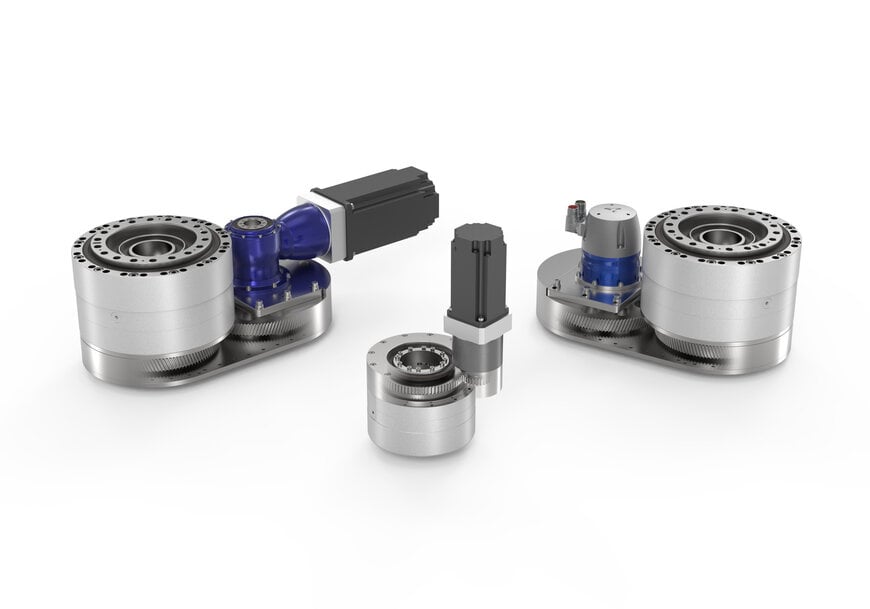
Many drive axes in robotics, semiconductor manufacturing, satellite tracking antennas and machine building must combine a high gear ratio, precise positioning and a hollow shaft for routing cables or media, often within very limited installation space. With the Galaxie® GA, WITTENSTEIN galaxie presents a precision hollow-shaft gearbox for parallel-axis drive solutions with standard solid-shaft motors. The gearbox premieres at SPS – Smart Production Solutions 2026, held in Nuremberg, Germany, from 24 to 26 November 2026 (Hall 4, Stand 4-221).
The Engineering Challenge of Hollow Shaft Drives
Hollow-shaft gearboxes allow cable bundles, media lines, shafts or other functional elements to pass centrally through the drive axis. When standard solid-shaft servo motors are used, however, the motor cannot simply be mounted in line with the bore. Designers therefore need a parallel-axis arrangement that keeps the hollow shaft free while still delivering the torsional stiffness and precision required for demanding positioning tasks.
Gearbox Architecture and Modular Pre-Stages
The Galaxie® GA is a functional further development within the Galaxie® brand family. It is based on a single-stage gearbox from the Galaxie® accuracy line with hollow shaft or on a miniaturised Galaxie® gearbox. On the parallel-axis side, planetary and right-angle pre-stages from WITTENSTEIN alpha can be integrated in single-stage or multi-stage versions. Machine builders can select solid-shaft motors according to design recommendations or manufacturer specifications and combine them with a Galaxie® GA to create a drive solution matched in performance and form factor.
Full Hollow Shaft Functionality with Solid Shaft Motors
Regardless of the selected pre-stage or motor connection, drive systems with a solid-shaft motor and a Galaxie® GA gear stage benefit from the high torque density, high torsional stiffness and zero backlash of the Galaxie® technology, as well as from the design advantages of a continuous hollow shaft. Cable bundles, media lines, a shaft or other functional elements can be routed centrally through the drive, and therefore protected and secured, instead of running along the outside of the machine structure. This considerably simplifies integration into robots, satellite tracking systems and compact machines.
Gear Ratios from i = 31 to over i = 3100
Further design freedom results from integration-oriented variants, for example motor, spur gear stage and gearbox in U-shaped or Z-shaped configurations, with variable centre distances. With total ratios from i = 31 to over i = 3100, the Galaxie® GA covers a wide application range, from dynamic motion axes to extremely slow, high-torque positioning applications. The wide ratio range also creates additional freedom when optimising the complete drive system. To record the actual position of the output directly, the new gearbox offers the option of integrating an output-side encoder.
How the Galaxie Single Tooth Principle Works
Galaxie® gearboxes are single-tooth thrust gearboxes. Their kinematics are based on the principle of almost full-surface contact during power transmission, instead of the line contact found on conventional tooth flanks. According to WITTENSTEIN, this results in high torsional stiffness, torque density and precision, which the Galaxie® GA makes available for space-saving, parallel-axis drive solutions with solid-shaft motors while leaving maximum freedom in mechanical design.
Additional Context:
This section details technical specifications and competitive benchmarking not included in the original product announcement.
Precision joints in industrial robots and positioning systems frequently use strain wave gears or cycloidal gearboxes, which are also available with hollow shafts and very low backlash. WITTENSTEIN positions the Galaxie® principle as an alternative to these established designs with a focus on higher torsional stiffness and torque density, while the Galaxie® GA specifically targets applications in which a standard solid-shaft motor has to be combined with a through-bore. Routing cables and media through hollow shafts is a widely used design approach in robot joints and antenna positioners, because it reduces cable wear and the risk of cables twisting or snagging during rotation.
Edited by Natania Lyngdoh, Induportals editor, with AI assistance.
www.wittenstein-group.com
