
www.magazine-industry-usa.com
25
'26
Written on Modified on
Photovoltaic Photocoupler for Automotive Solid-State Relays
Toshiba's TLX9909 drives external high-voltage power MOSFETs with adjustable turn-off time for battery management systems, on-board chargers and inverters.
www.global.toshiba
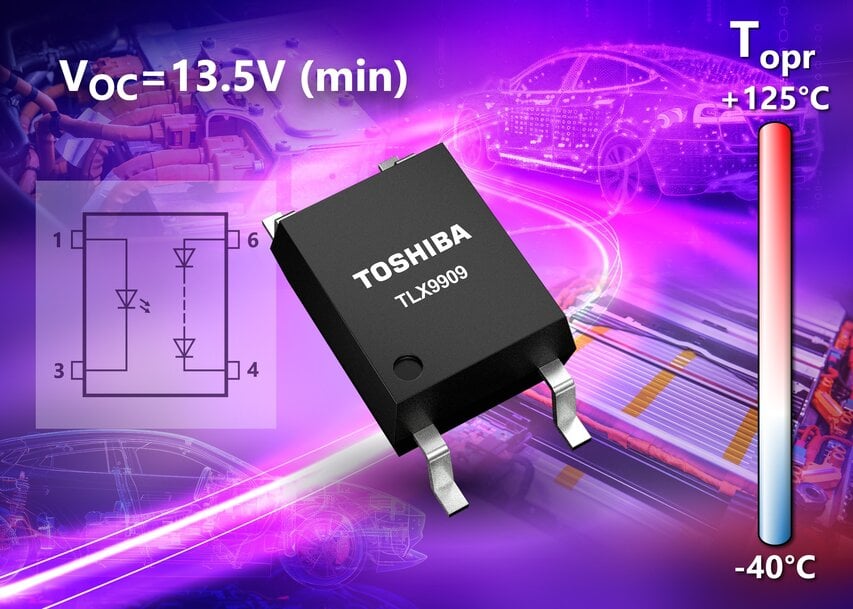
Vehicle electrification is pushing carmakers to replace mechanical relays with semiconductor switching in high-voltage circuits. Toshiba Electronics Europe has introduced the TLX9909, a photovoltaic-output photocoupler designed to drive external power MOSFETs in solid-state relays (SSRs) for battery management systems (BMS), on-board chargers (OBC) and inverter units.
From mechanical relays to solid-state relays
SSRs have no moving contacts and therefore avoid the mechanical wear associated with electromechanical relays. The design challenge is to achieve the switching characteristics the system requires while keeping the drive circuit simple, in particular the number of components needed to generate an isolated gate voltage.
How the photovoltaic output works
In the TLX9909, light emitted by the LED on the input side falls on a photodiode array that directly generates the voltage needed to drive the gate of an external MOSFET. This removes the need for a separate secondary power supply or a charge pump circuit, reducing component count and system size. The same structure provides isolation between the low-voltage control side and the power circuit.
Configurable MOSFET turn-off time
Unlike Toshiba's TLX9910, which integrates a gate discharge control circuit, the TLX9909 allows engineers to configure an external discharge circuit. By dimensioning this circuit, designers can adjust the MOSFET turn-off time to the connected device and the system requirements. They can therefore choose between the externally configurable discharge of the TLX9909 and the integrated solution of the TLX9910, depending on their switching control needs and component count.
Technical specifications
At an input forward current of 10 mA and an ambient temperature of 25 °C, the device delivers a minimum open-circuit output voltage (VOC) of 13.5 V, matching the TLX9910 and higher than the 7 V minimum of the TLX9905 and TLX9906. A higher gate voltage widens the range of high-voltage power MOSFETs that can be driven. Under the same conditions, the minimum output short-circuit current is 8 µA. Combined with an external MOSFET, the photocoupler enables high-voltage, high-current switching circuits that are difficult to implement with photorelays that integrate their own MOSFETs.
The TLX9909 is AEC-Q101 compliant, operates from -40 °C to +125 °C (absolute maximum ratings) and provides a minimum isolation voltage of 3750 Vrms. It is housed in a compact 4-pin SO6 package measuring 3.7 × 7.0 × 2.1 mm (typical). Volume shipments started in November 2026.
Additional Context
This section details technical specifications and competitive benchmarking not included in the original product announcement.
Photovoltaic-output photocouplers, also known as photovoltaic MOSFET drivers, are an established way to drive isolated switches without an auxiliary supply on the secondary side. Toshiba introduced the TLX9910, with its integrated discharge circuit, in December 2023; the TLX9909 keeps its 13.5 V minimum output voltage while leaving discharge control external. The AEC-Q101 standard, defined by the Automotive Electronics Council, specifies the stress tests for qualifying discrete semiconductors for automotive use. The spread of 400 V and 800 V battery architectures in electric vehicles is increasing demand for isolated solid-state relays for functions such as pre-charge, disconnection and insulation monitoring in battery packs.
Edited by Sucithra Mani, Induportals editor – adapted by AI.
www.toshiba.semicon-storage.com
