
www.magazine-industry-usa.com
10
'26
Written on Modified on
Unified Robotics Platform Accelerates Physical AI Integration
NXP Semiconductors launched its unified robotics platform to resolve integration bottlenecks across real-time control, perception, and autonomous physical AI systems.
www.nxp.com
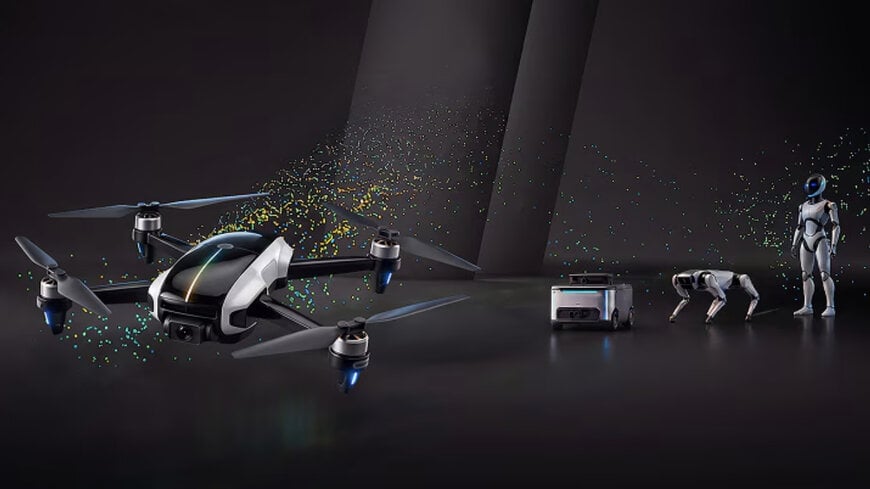
Integrating heterogeneous robotics subsystems ranging from high-throughput neural processing to deterministic motor control typically presents severe integration bottlenecks for autonomous systems operating in industrial and commercial environments. To resolve these cross-domain engineering hurdles, the platform establishes a structured baseline that coordinates sensing, real-time actuation, machine intelligence, and secure networking across unmanned platforms and industrial automation systems.
Hardware Decoupling and Deterministic Communication Architecture
Autonomous robotic architectures require discrete processing domains to manage tasks with sharply divergent timing constraints. Real-time motor commutation and trajectory execution cannot share execution pipelines with non-deterministic artificial intelligence workloads without risking control instability. The unified robotics platform addresses this through the Neural Axis Architecture, an approach that delineates vision-based edge processing from low-latency control loops while maintaining secure inter-subsystem data transport.
By combining an open-source, modular software development kit (SDK) with pre-validated reference modules, developers can build foundational robotic behavior sequentially. Control loops can be evaluated independently within isolated hardware nodes before integrating perception-driven navigation stacks. Communication between distributed processing nodes relies on established industrial and automotive networking topologies, including single-pair Ethernet interfaces that reduce payload weight and cable complexity in mobile robotic airframes and mobile robotics chassis.
Modular Reference Designs and Subsystem Specifications
The initial hardware deployment targets autonomous aerial vehicles using four modular reference elements, each addressing distinct computation and control profiles:
High-Level Perception and Autonomous Compute: The NavQ95 computing node uses the i.MX 95 applications processor to run vision processing, mapping algorithms, and higher-level mission planning tasks.
Flight Management and Real-Time Actuation: The Tropic Vehicle Management Unit/Flight Management Unit (VMU/FMU) integrates the i.MX RT1064 crossover microcontroller (MCU), handling real-time stabilization routines and telemetry parsing.
Intelligent Sensor Integration: The sensor aggregation node is built on the MCX N947 microcontroller, utilizing an automotive-grade 100Base-T1 physical layer to link edge sensors deterministically over single twisted-pair wiring.
Motor Actuation: Actuation is executed through an AM32-compliant electronic speed controller (ESC) based on the MCX A13 MCU, designed to manage high-frequency pulse-width modulation (PWM) signals for brushless motor commutation.
Software Abstraction Layers and Robotic Operating Systems
Standardizing embedded robotics software across disparate processing architectures typically demands extensive driver adaptation. The modular SDK addresses this fragmentation by packaging device drivers, middleware, and board support packages compatible with widely adopted open-source frameworks.
The software stack integrates ROS 2 for high-level node orchestration and inter-process messaging, the PX4 autopilot software stack for navigation guidance and aerodynamic stabilization, and the Zephyr real-time operating system (RTOS) for deterministic, resource-constrained microcontrollers. This abstraction model ensures that security measures and hardware safety functions implemented at the silicon level operate continuously regardless of higher-level application code behavior.
Industrial and Operational Applications
The platform targets multi-rotor inspection drones, last-mile delivery unmanned aerial vehicles, service robots, and autonomous mobile robots (AMRs) operating across warehouse logistics, industrial inspection, and automated agriculture.
In automated warehousing, for instance, deploying automated guided platforms requires balancing high-speed optical obstacle detection with certified safety-stop functions. Utilizing validated embedded blocks enables engineering teams to compress initial prototyping timelines from several months to standard verification cycles, accelerating deployment within physical environments that require continuous operational reliability.
Additional Context:
This section details technical specifications and competitive benchmarking not included in the original product announcement.
Heterogeneous computing architectures are increasingly displacing monolithic computing boards across the embedded robotics sector. As physical artificial intelligence transitions toward autonomous collaborative machines, design teams face heightened compliance requirements under safety standards such as IEC 61508 and ISO 13849 for industrial machinery, alongside emerging safety frameworks for unmanned aircraft systems.
In comparative robotics development architectures, single-board computing solutions typically adopt one of two industry models: centralized compute platforms that route sensor data and motor drive logic directly into high-power processing units (such as monolithic system-on-chips like the NVIDIA Jetson series), or split-domain architectures that separate real-time microcontrollers from neural network accelerators (such as paired architecture configurations using STMicroelectronics STM32 MCUs alongside separate host vision processors).
Centralized models offer substantial GPU-driven inferencing capabilities for spatial computing, but they routinely encounter challenges in maintaining microsecond-level determinism for motor control without dedicated co-processors. Conversely, custom discrete designs utilizing standard general-purpose microcontrollers often demand substantial engineering resources to implement communication stacks, secure boot flows, and real-time network drivers across disconnected components.
The integration of 100Base-T1 Ethernet directly into the sensor aggregation layer reflects a broader industry movement toward automotive Ethernet standards, replacing legacy UART and SPI communication links. This transition provides 100 Mbps full-duplex data rates over unshielded single twisted pairs, providing higher bandwidth for multidirectional lidar, radar, and imaging sensor networks while mitigating electromagnetic interference (EMI) in dynamic motor environments.
Edited by Sucithra Mani, Induportals editor – adapted by AI.
www.nxp.com
