
CODESYS to showcase virtual safety and AI at ADM Montreal 2026
The company partners with MESCO Engineering and Intel to present hardware-independent SIL3 control and local AI generation.
www.codesys.com
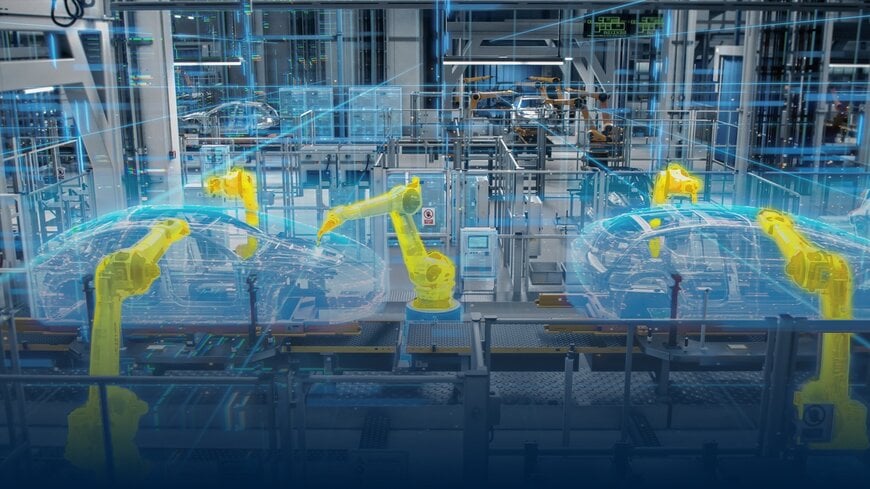
CODESYS, a global provider of hardware-independent industrial automation software, will exhibit its latest industrial safety and on-device artificial intelligence solutions at the Advanced Design & Manufacturing (ADM) expo in Montréal, Quebec, from November 10 to 12, 2026. Visitors to Booth 1126 will experience live software demonstrations developed in collaboration with MESCO Engineering and Intel. To support the local Canadian market and welcome French-speaking attendees, the CODESYS team will also be joined by Yannick Asselin of Think Automation.
Hardware-independent SIL3 virtual safety
In collaboration with MESCO Engineering, CODESYS will demonstrate its virtual safety software, which is certified according to the rigorous IEC 61508 SIL3 standard. Unlike traditional safety architectures that require specialized, proprietary safety PLCs, the CODESYS solution runs on standard industrial PC (IPC) hardware. It seamlessly integrates into the standard CODESYS Development System, allowing engineers to deploy scalable, distributed control architectures that support mixed safety and non-safety environments while significantly reducing dependence on specific hardware manufacturers.
Local AI code generation with Intel OpenVINO
Addressing the growing demand for AI in automation without compromising corporate data security, CODESYS is partnering with Intel to showcase AI-assisted engineering running entirely on-device. Utilizing the Intel OpenVINO™ toolkit, the platform provides local AI capabilities—such as the automatic generation of Program Organization Units (POUs) and PLC code, alongside automatic syntax error detection and correction. Because the AI model is deployed locally on the engineering machine, users can leverage advanced prompting and code generation support without a cloud connection, ensuring that proprietary source code and intellectual property remain strictly within the organization's firewall.
Additional Context: SIL3 virtualization and neural network optimization at the edgeThis section details the software isolation mechanics and edge AI compilation principles not included in the original press release.
Achieving IEC 61508 SIL3 (Safety Integrity Level 3) certification on a standard, commercial-off-the-shelf (COTS) industrial PC requires profound software architecture innovations. In a traditional hardware safety PLC, physical redundancy (such as dual microprocessors continuously cross-checking each other) ensures that a hardware failure instantly triggers a safe state. To virtualize this on a standard multi-core IPC, the software must utilize strict spatial and temporal isolation, often via a certified hypervisor or real-time operating system (RTOS) partitioning. This guarantees that if a non-safe operating system (like Windows or Linux running an HMI) crashes, the safety-critical control partition continues executing its deterministic safety tasks uninterrupted, mathematically meeting the required probability of failure on demand (PFD).
Furthermore, running Large Language Models (LLMs) for AI code generation locally on a standard engineering workstation presents severe computational bottlenecks. Standard AI models typically require massive cloud-based discrete GPUs to process billions of neural network weights. Intel’s OpenVINO™ (Open Visual Inference and Neural network Optimization) toolkit solves this by heavily optimizing and compressing these AI models—using techniques like quantization (reducing 32-bit floating-point weights to 8-bit integers)—so they can execute rapidly on standard x86 CPUs or integrated graphics. This allows automation engineers to leverage a powerful AI co-pilot completely offline, eliminating the cybersecurity risks and compliance issues associated with transmitting proprietary machine logic to external cloud servers.
Edited by an industrial journalist, Lekshman Ramdas, with AI assistance.
www.lselectricamerica.com
