
www.magazine-industry-usa.com
12
'26
Written on Modified on
Antaira introduces STE-6104C-T-V2 industrial serial-to-Ethernet gateway
The rugged 4-port gateway connects legacy RS-232/422/485 field devices to modern Ethernet networks for remote monitoring.
www.antaira.com
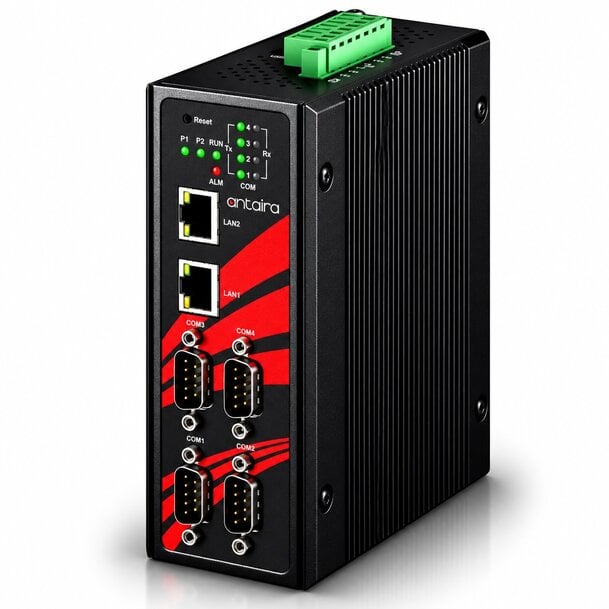
Antaira Technologies has launched the STE-6104C-T-V2, a robust 4-port industrial gateway designed to seamlessly bridge legacy serial equipment with modern Ethernet (TCP/IP) networks. By converting serial data into standard network traffic, the device enables operators to integrate proven PLCs, CNC machines, meters, and RTUs into centralized SCADA systems and IIoT platforms. This modernization approach allows industrial facilities to unlock critical machine data for analytics and remote management without the costly replacement of existing field hardware.
Bridging legacy hardware and modern IT networks
Designed to serve factory automation, utility substations, and water treatment facilities, the STE-6104C-T-V2 eliminates the need for point-to-point cabling and manual data collection trips. The gateway supports multiple operational architectures, including RAW TCP Server, TCP Client, UDP, Virtual COM, and Tunneling modes. This protocol flexibility allows existing Windows-based control software to interact with remote field devices unchanged, or enables operators to replace long, vulnerable serial cable runs with secure Ethernet routing, bringing immediate visibility to remote machine status.
Rugged design for harsh industrial environments
To ensure continuous operation in demanding environments, the gateway features dual 10/100 Mbps Fast Ethernet ports for network redundancy, maintaining communications even if a primary link fails. The four RS-232/422/485 ports support data rates up to 921 Kbps and incorporate 15KV ESD protection on every serial line to safeguard against voltage spikes. Housed in a rigid IP30 metal enclosure with DIN-rail and wall mounting options, the unit is rated for extreme operating temperatures ranging from -40°C to 85°C. Setup and troubleshooting are streamlined via an integrated web server, serial console, and Telnet management.
Additional Context: Overcoming serial communication limitations
This section details technical specifications and competitive benchmarking not included in the original product announcement.
Legacy serial protocols like RS-485 and RS-232 operate on point-to-point or daisy-chained topologies, inherently limiting communication distances (typically 15 meters for RS-232 and 1,200 meters for RS-485) and preventing simultaneous multi-node polling from advanced control systems. By encapsulating serial payloads into TCP/IP packets (Serial-over-LAN), an industrial device server allows centralized SCADA software to poll remote nodes over standard fiber or copper Ethernet backbones. This overcomes physical distance limitations and enables data historians to access field-level metrics previously trapped in isolated subnets. Furthermore, Virtual COM port mapping allows legacy legacy application software to interact with the IP-routed hardware exactly as if it were directly connected to a local motherboard via a standard physical serial interface, completely bypassing the need to rewrite legacy software drivers.
Edited by an industrial journalist, Lekshman Ramdas, with AI assistance.
www.antaira.com
-2296-71282-204124.png)