
www.magazine-industry-usa.com
01
'26
Written on Modified on
Modular Environmental Monitoring Systems for High-Density Data Center Infrastructure
Vaisala introduces the Indigo Supervisor to consolidate daisy-chained environmental probes into a single building management system interface.
www.vaisala.com
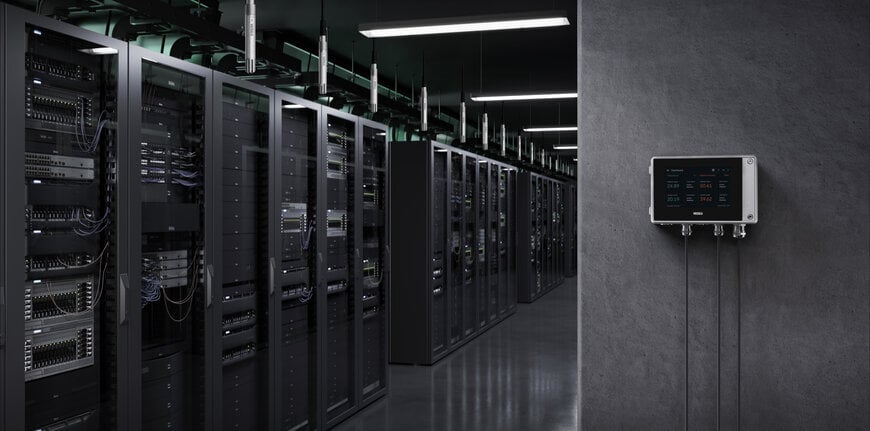
Accelerating artificial intelligence compute densities and condensed facility commissioning timelines require data center operators to implement granular thermal and humidity tracking without introducing cabling sprawl or maintenance bottlenecks. To resolve these installation and integration challenges, Vaisala has introduced the Indigo Supervisor, a central host unit designed to manage up to 100 environmental measurement points as a unified network across critical infrastructure spaces.
Engineering Challenges in High-Density Facility Monitoring
Modern data center halls housing high-power server racks generate microclimates requiring strict temperature and dew point regulation to prevent both electronic hardware throttling and electrostatic discharge or condensation risks. Traditional environmental instrumentation architectures mandate discrete home-run wiring from individual sensor transmitters back to central supervisory controllers, creating substantial cabling overhead, complex input/output channel mapping, and extended commissioning cycles.
As facilities expand to support power-intensive computing loads, managing individual sensors across data halls, battery rooms, electrical switchgear spaces, and mechanical corridors becomes labor-intensive. Maintenance personnel require localized visibility for on-site diagnostic checks alongside standardized integration paths into centralized supervisory software, all while avoiding downtime during sensor recalibration or field replacement.
System Architecture and Daisy-Chain Topology
The Indigo Supervisor operates as a central supervisory host for Vaisala compact digital measurement probes. The hardware architecture supports up to two independent digital probe chains, with each daisy chain accommodating up to 50 individual measurement probes. This topology eliminates the need for separate point-to-point sensor wiring by running multi-drop serial lines directly through monitored aisles and technical areas.
The host platform natively interfaces with specific Vaisala digital sensing units, including the XMP10 humidity and temperature probe, the HMP110 and HMP113 relative humidity and temperature probes, and the TMP115 temperature-only probe. Interfacing with probes such as the XMP10 allows the system to capture relative humidity, ambient temperature, and calculated thermal properties such as dew point temperature with HUMICAP sensor stability.
Commissioning and Facility Network Integration
To streamline installation schedules across large mechanical footprints, the Indigo Supervisor provides multi-tiered configuration options. System parameters, addressing schemes, and probe tag mappings can be generated externally and imported via structured CSV configuration files, or executed through integrated web-based configuration tools and the local front-panel touchscreen.
For site operations, the onboard touchscreen interface displays centralized dashboards, multi-point measurement trends, alert logs, and probe calibration histories. Hot-swapping or replacing active sensing heads can be performed directly through the local user interface without interrupting the broader bus architecture.
At the supervisory network level, the device bridges the distributed probe chains to high-level building management systems and data center infrastructure management platforms using a single Modbus TCP Ethernet interface. This single-connection architecture consolidates up to 100 discrete data points into organized register maps, reducing the software polling overhead and protocol gateway requirements typically imposed on facility automation controllers.
Industrial Deployment and Application Workflows
While structured primarily around data center white spaces and cooling galleries, the modular architecture fits secondary critical environments requiring dense, multipoint environmental validation. These include pharmaceutical cleanrooms, walk-in cold storage facilities, biological research laboratories, and distributed industrial process areas where distributed sensor wiring poses physical installation constraints.
Anu Kätkä, Product Line Manager for HVAC and Critical Buildings at Vaisala, noted that rapid expansions in computational capacity have fundamentally altered how support infrastructure must be deployed, explaining that managing large sensor fleets individually is no longer viable and that operators require a system-level approach that scales consistently with capacity expansions.
Additional Context:
This section details technical specifications and competitive benchmarking not included in the original product announcement.
Environmental monitoring in mission-critical facilities is traditionally divided into three implementation models: point-to-point analog transmitters, proprietary wireless sensor mesh nodes, and multidrop serial networks.
Analog point-to-point sensors (operating on 4–20 mA or 0–10 V loops) demand dedicated analog input channels on building management system field panels, which increases controller hardware costs and cable containment volume. Wireless mesh networks eliminate structural cabling but introduce radio-frequency planning challenges inside metal-dense data halls, alongside ongoing battery maintenance requirements and cybersecurity vetting for wireless transmission protocols.
Standard industrial multidrop approaches frequently rely on raw RS-485 Modbus RTU loops wired directly into central automation plcs. While cost-effective, raw multidrop loops lack localized display interfaces and often complicate field maintenance; addressing conflicts or single-point physical line disruptions can disable entire communication trunks without offering clear localized diagnostic insight.
By incorporating a dedicated physical host unit equipped with a local touchscreen, dual-channel physical isolation (two chains of 50 probes), and Modbus TCP output translation, the Indigo Supervisor acts as an edge aggregator. This arrangement isolates physical RS-485 transceiver segments while presenting an aggregated Modbus register table to Ethernet-based building management networks. Furthermore, pairing with Platinum RTD (Pt1000) and thin-film polymer capacitive sensors (HUMICAP) provides certified annual stability within 0.5% relative humidity drift, meeting ASHRAE Thermal Guidelines for Data Processing Environments for Class A1 to A4 facilities without requiring quarterly sensor recalibration.
Edited by Natania Lyngdoh, Induportals editor, with AI assistance.
www.vaisala.com
