
www.magazine-industry-usa.com
02
'26
Written on Modified on
GEA launches GEA AWP portfolio in North America to serve growing market demand
Customers in North America now have access to local sales, application support and service through GEA Systems North America's established network of refrigeration and heating experts.
www.gea.com
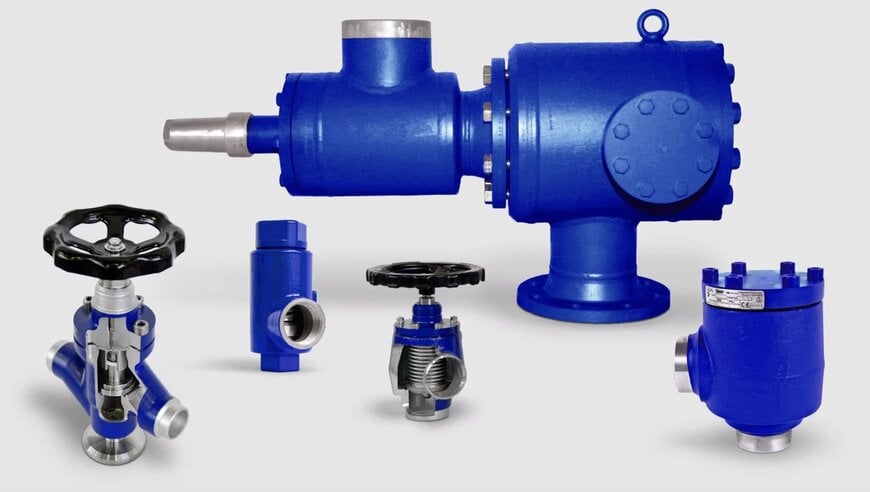
GEA Systems North America announced the commercial launch of the GEA AWP valve and component portfolio in North America, meeting rising regional demand across food processing, cold storage, industrial manufacturing, and marine sectors. Engineered and produced at GEA AWP's manufacturing facility in Prenzlau, Germany, the product lineup includes industrial valves, oil regulation systems, and auxiliary components backed by local application engineering, sales, and field support through GEA’s North American service infrastructure.
High-Pressure Ratings and Materials of Construction
Engineered to withstand demanding industrial thermal conditions, the GEA AWP component range covers an expansive operating envelope:
- Dimensional Range and Pressure Ratings: Standard and custom component designs are available in nominal pipe sizes ranging from 1/8 inch to 20 inches, supporting operating pressure envelopes up to 2,320 psi.
- Thermal Operating Limits: Rated for broad process temperatures spanning from -76°F to +392°F (-60°C to +200°C).
- Metallurgy and Materials: Components are fabricated from stainless steel, standard carbon steel, and low-temperature carbon steel to ensure fracture toughness and mechanical integrity in sub-zero and corrosive fluid environments.
- Digital Sizing Tools: Customers and system designers can utilize the proprietary ValveCalc software platform to match specific operating conditions with optimized valve models.
Modular Fabrication and Industrial Applications
Utilizing a modular production architecture, GEA AWP accommodates customized valve configurations, including application-specific connection types, custom flanges, tailored face-to-face installation lengths, and specialized gland packing materials to satisfy customer traceability requirements. Multiple valve bodies can also be integrated into pre-assembled, factory-tested, and validated monolithic assemblies prior to field dispatch.
The product line is engineered for a diverse range of thermal applications, including chemical synthesis, food and beverage processing, concrete cooling, cold storage logistics, marine vessels, oil and gas processing, and recreational ice facilities. All components comply with major international, regional, and national safety accreditations.
Additional Context
This section details technical specifications not included in the original news release.
Industrial refrigeration valves utilized in natural refrigerant loops (such as anhydrous ammonia, R-717, and carbon dioxide, R-744) require specialized sealing integrity to prevent fugitive atmospheric emissions. In sub-critical and transcritical CO2 installations where operating pressures routinely exceed 50 to 140 bar, valve bodies utilize high-tensile cast or forged carbon steel grades conforming to ASTM A350 LF2 low-temperature impact specifications to prevent brittle cleavage failure during rapid expansion cycles. Spindle sealing arrangements deploy virgin PTFE, graphite-reinforced fluoropolymer, or extended metal bellows seals combined with secondary O-rings, ensuring zero-leakage stem packing performance under extreme thermal cycling and severe pressure shocks.
Safety relief and back-pressure regulating valves deployed in high-capacity refrigeration circuits are designed in accordance with ASME Boiler and Pressure Vessel Code Section VIII and ASHRAE 15 safety standards for mechanical refrigeration. Internal flow geometries utilize hydrodynamically contoured plugs and full-bore seat orifices to deliver high flow coefficients (Cv) while minimizing turbulence-induced cavitation and acoustic vibration. For low-temperature service below minus 40 degrees Fahrenheit, internal seating discs utilize modified elastomers or virgin PTFE-to-metal seating interfaces that maintain resilience without hardening, ensuring hermetic shut-off class VI bubble-tight seals during closed isolation states.
Edited by Romila DSilva, Induportals Editor, with AI assistance.
Utilizing a modular production architecture, GEA AWP accommodates customized valve configurations, including application-specific connection types, custom flanges, tailored face-to-face installation lengths, and specialized gland packing materials to satisfy customer traceability requirements. Multiple valve bodies can also be integrated into pre-assembled, factory-tested, and validated monolithic assemblies prior to field dispatch.
The product line is engineered for a diverse range of thermal applications, including chemical synthesis, food and beverage processing, concrete cooling, cold storage logistics, marine vessels, oil and gas processing, and recreational ice facilities. All components comply with major international, regional, and national safety accreditations.
Additional Context
This section details technical specifications not included in the original news release.
Industrial refrigeration valves utilized in natural refrigerant loops (such as anhydrous ammonia, R-717, and carbon dioxide, R-744) require specialized sealing integrity to prevent fugitive atmospheric emissions. In sub-critical and transcritical CO2 installations where operating pressures routinely exceed 50 to 140 bar, valve bodies utilize high-tensile cast or forged carbon steel grades conforming to ASTM A350 LF2 low-temperature impact specifications to prevent brittle cleavage failure during rapid expansion cycles. Spindle sealing arrangements deploy virgin PTFE, graphite-reinforced fluoropolymer, or extended metal bellows seals combined with secondary O-rings, ensuring zero-leakage stem packing performance under extreme thermal cycling and severe pressure shocks.
Safety relief and back-pressure regulating valves deployed in high-capacity refrigeration circuits are designed in accordance with ASME Boiler and Pressure Vessel Code Section VIII and ASHRAE 15 safety standards for mechanical refrigeration. Internal flow geometries utilize hydrodynamically contoured plugs and full-bore seat orifices to deliver high flow coefficients (Cv) while minimizing turbulence-induced cavitation and acoustic vibration. For low-temperature service below minus 40 degrees Fahrenheit, internal seating discs utilize modified elastomers or virgin PTFE-to-metal seating interfaces that maintain resilience without hardening, ensuring hermetic shut-off class VI bubble-tight seals during closed isolation states.
Edited by Romila DSilva, Induportals Editor, with AI assistance.
-2296-71282-204124.png)