
www.magazine-industry-usa.com
25
'26
Written on Modified on
Industrial Wi-Fi 6 Access Points for Automation Networks
Antaira Technologies debuts dual-radio and single-radio Wi-Fi 6 access point routers at Automate 2026.
www.antaira.com
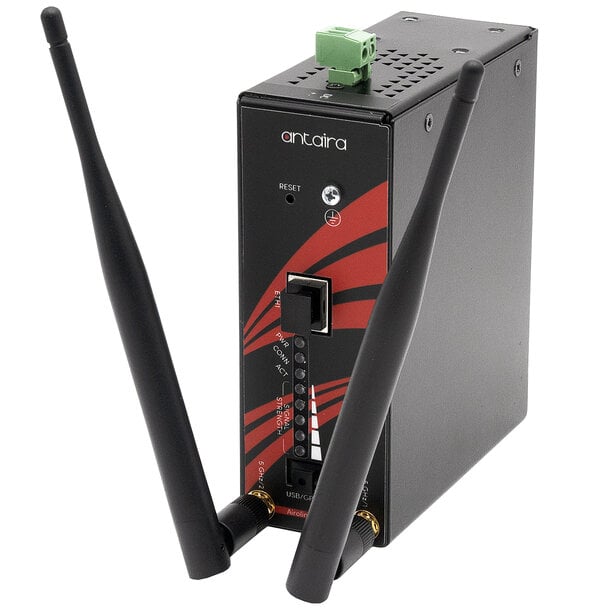
Antaira Technologies has introduced two new industrial IEEE 802.11ax (Wi-Fi 6) access point and router platforms—the AIROLINX-6-MAX-DR-T and the AIROLINX-6-DR-T—debuting the hardware at the Automate 2026 exhibition in Chicago. The devices are engineered to provide high-throughput wireless connectivity and integrated network routing capabilities for operational technology (OT) environments, including security, transportation, and industrial automation networks.
Dual-Radio and Single-Radio Architectures
The AIROLINX-6-MAX-DR-T features a dual-band, dual-radio architecture supporting 802.11a/b/g/n/ac/ax wireless standards, while the AIROLINX-6-DR-T provides similar performance capabilities utilizing a single-radio configuration. Both hardened units combine wireless access point functionality with native routing protocols. The platforms are designed to handle high-bandwidth and low-latency data transmission for complex industrial topologies, supporting SCADA systems, remote monitoring nodes, vehicle-to-infrastructure (V2I) communication, and high-resolution IP surveillance cameras.
Antenna Configuration and RF Modularity
Both AP/Router models are equipped with external antenna arrays capable of providing a baseline wireless coverage radius of up to 0.4 miles utilizing the standard included hardware. To accommodate specialized industrial deployments requiring extended range or highly directional coverage, the platforms interface with a broader ecosystem of external dish, sector, horn, and panel antennas. This modularity allows network engineers to customize the radio frequency (RF) propagation footprint according to the specific spatial constraints of manufacturing facilities or outdoor transit intersections.
Additional Context: This section details technical specifications not included in the original announcement
In industrial wireless networking, the transition to the IEEE 802.11ax (Wi-Fi 6) standard introduces the critical determinism required for modern Industrial Internet of Things (IIoT) applications. Unlike the previous 802.11ac (Wi-Fi 5) standard, which relied entirely on OFDM (Orthogonal Frequency-Division Multiplexing), Wi-Fi 6 utilizes OFDMA (Orthogonal Frequency-Division Multiple Access). OFDMA mathematically subdivides a standard Wi-Fi channel into smaller resource units (RUs). This allows a single access point to transmit and receive data from multiple industrial clients—such as Automated Guided Vehicles (AGVs) or Programmable Logic Controllers (PLCs)—simultaneously during the exact same transmission window. Furthermore, Wi-Fi 6 introduces 1024-QAM (Quadrature Amplitude Modulation). By plotting data over 1024 distinct constellation points, the modulation scheme packs more data into each symbol, increasing raw spectral efficiency and throughput by approximately 25% compared to the 256-QAM limitation of Wi-Fi 5. These protocol enhancements drastically reduce network latency, packet collision, and jitter in dense, metal-heavy RF environments like automated factory floors.
Edited by Lekshman Ramdas, Induportals editor – adapted by AI.
www.antaira.com
-2296-71282-204124.png)