
www.magazine-industry-usa.com
19
'26
Written on Modified on
Precise Distance Measurement for Short-Range Wireless Sensor Networks
Rutronik introduces a compact hardware platform leveraging the latest Bluetooth positioning standards to enable efficient asset tracking without complex ultra-wideband architectures.
www.rutronik.com
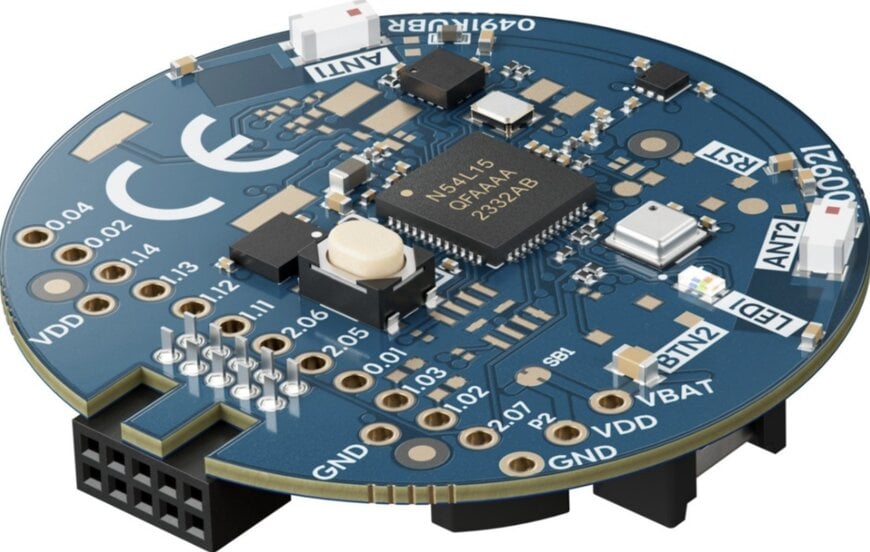
Rutronik is releasing the Nordic Semiconductor nRF54L15 Tag, a prototyping platform designed to accelerate the development of applications utilizing Bluetooth Channel Sounding and Matter protocols. This hardware solution targets battery-powered asset tracking within the digital supply chain, medical equipment monitoring, and secure access systems by providing accurate distance measurement over standard short-range wireless networks.
Overcoming Indoor Positioning Constraints
Traditional satellite-based navigation systems such as GPS and GNSS provide highly accurate outdoor positioning but face physical signal limitations indoors. Conversely, Ultra-Wideband (UWB) technology delivers exact indoor measurements but introduces increased system costs and hardware complexity due to its requirement for additional radio frequency components and specialized antennas. Bluetooth 6.0 introduces Channel Sounding, an updated standard that facilitates accurate distance measurement between two devices using phase-based ranging and time-of-flight calculations. This mechanism provides an alternative that utilizes existing wireless infrastructure to achieve reliable ranging for short-range distance estimation, significantly reducing power consumption compared to alternate positioning approaches.
Hardware Architecture for Distance Estimation
The Nordic nRF54L15 Tag serves as a compact 33-millimeter prototyping unit built around the nRF54L15 ultra-low-power wireless system-on-chip. The hardware employs a dual-antenna design specifically engineered to support the phase-based ranging required by the Channel Sounding specification, enabling robust distance estimation. This architecture allows engineers to implement precise proximity detection without integrating secondary wireless technologies. The multiprotocol chip supports standard short-range networks, including Bluetooth LE, Matter, Thread, Zigbee, Near Field Communication, and proprietary 2.4 GHz protocols, making it applicable for diverse hardware ecosystems such as smart home devices and smart locks.
Sensor Integration and Edge Processing Capabilities
Beyond base radio functionality, the platform incorporates integrated environmental, acceleration, and motion sensors. This hardware array supports edge AI processing, allowing devices to run machine learning models locally for tasks such as anomaly detection in predictive maintenance setups and gesture recognition in wearables. Within a digital supply chain, this translates to battery-powered asset tags that monitor both location and condition simultaneously. The platform is structurally optimized for energy-constrained designs, aligning with the operational requirements of medical trackers and devices operating within the Apple Find My and Google Find My device networks. By eliminating the need to design custom boards for initial testing, the module reduces engineering cycles for new proximity-aware hardware.
Additional Context
This section details technical specifications and competitive benchmarking not included in the original news release.
Bluetooth Channel Sounding directly competes with Ultra-Wideband (IEEE 802.15.4z) and Wi-Fi Ranging (IEEE 802.11az) for indoor positioning applications. While UWB typically achieves sub-10-centimeter accuracy, it draws significantly higher peak currents during transmission and requires dedicated transceiver hardware. Channel Sounding aims for sub-meter accuracy (approximately 10 to 50 centimeters) while maintaining the microampere-level power consumption standard characteristic of Bluetooth Low Energy. In the low-power wireless market, the Nordic nRF54L15 competes with single-chip solutions like the Silicon Labs BG24 and the Texas Instruments CC2340. However, the adoption of native hardware support for Bluetooth 6.0 phase-based ranging differentiates the nRF54Lx series. UWB chips from competitors such as NXP provide the benchmark for high-accuracy automotive access control, but the Nordic approach reduces the overall bill of materials by consolidating communication and ranging protocols into a single 2.4 GHz radio transceiver.
Edited by Aishwarya Mambet, Induportals Editor, with AI assistance.
www.rutronik24.com
