
Ingeteam Enables First U.S. Inverter-Based Solar EL Inspection
Electroluminescence testing at Acciona Energía’s Texas solar farm improves panel diagnostics, efficiency, and asset performance.
www.ingeteam.com
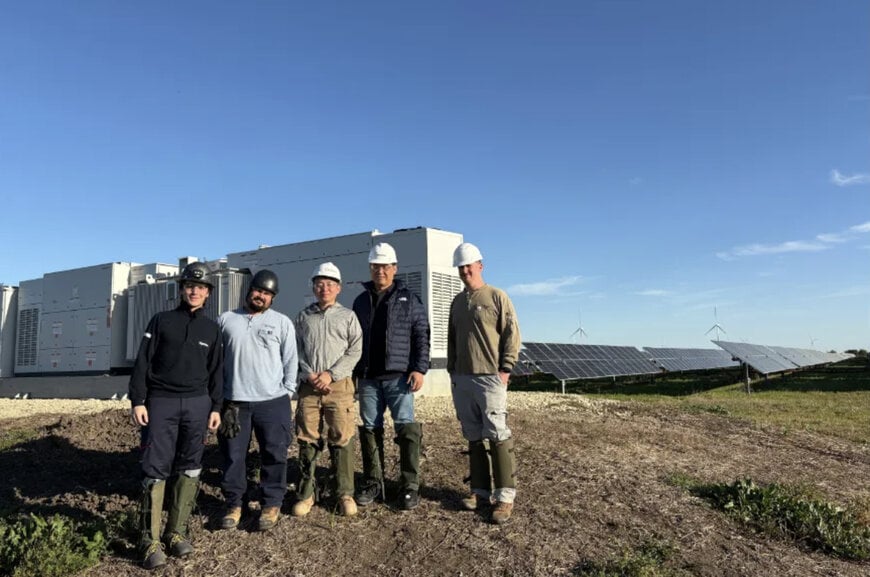
Ingeteam, in partnership with Acciona Energía and Quantified Energy, has completed the first utility-scale, inverter-fed electroluminescence inspection of photovoltaic modules within the United States. Executed at the 458 MWp Red-Tailed Hawk Solar Farm in El Campo, Texas, the diagnostic operation utilized the integrated hardware capabilities of Ingeteam central inverters to energize pre-selected solar sub-arrays. This engineering approach allowed autonomous drones to capture structural cell data across 18,125 individual modules without requiring external electrical equipment. The technical deployment establishes a localized benchmark for high-throughput automated asset management within the renewable energy sector. ### Inverter Driven Electroluminescence in Large Scale Photovoltaic Arrays Maintaining optimal asset efficiency at utility-scale photovoltaic installations requires advanced diagnostic methodologies to identify structural degradation prior to electrical failure. Electroluminescence testing serves as a definitive diagnostic tool by exploiting the physical properties of photovoltaic materials, which emit near-infrared radiation when stimulated by an external direct electrical current. Visualizing these emissions allows asset managers to map micro-cracks, mechanical cell defects, and manufacturing anomalies that remain completely invisible to standard thermal imaging or visual inspections. Historically, field-based electroluminescence verification was constrained by high operational friction, requiring maintenance teams to isolate individual string boxes and deploy specialized external alternating and direct current power supplies to back-feed electrical power into the solar strings. The integration of specialized firmware within the central inverters removes these logistical steps. By utilizing the internal power conversion circuitry of the existing plant infrastructure, the system reverses the standard power flow during non-generating hours, polarizing complete module sub-arrays simultaneously. This structural automation eliminates manual cable manipulation, improving field safety and compressing the required inspection window. ### Aerial Mapping Integration and Processing Performance The field execution at the Texas facility paired the inverter polarization sequence with an autonomous aerial data collection platform developed by Quantified Energy. Three INGECON SUN 3Power UL C Series central units, each rated at 3,222 kVA, were configured to energize the targeted solar strings in successive blocks. Operating under fully automated flight mapping protocols, specialized drone assets equipped with high-sensitivity near-infrared sensors scanned the active solar arrays, completing the scanning process within an operational window of two hours per inverter block. The combined hardware and software architecture scales up local operation and maintenance workflows, supporting data acquisition rates of up to 40,000 photovoltaic modules per night under optimal conditions. The resulting digital imagery undergoes multi-frame averaging and automated machine learning analysis to classify structural anomalies at the individual cell level. This highly granular data generation provides asset owners with verified structural baselines, which are essential for accelerating hardware warranty validations and resolving production-loss insurance claims. ### Operational Efficiency and System Level Standardization Transitioning diagnostic workflows to localized inverter-driven polarization yields measurable efficiency advantages within the digital supply chain. By substituting external testing generators with the native central power architecture, the plant minimizes auxiliary power consumption to the base operating draw of the inverter itself. This method eliminates the risk of string-box cable damage or connector degradation associated with manual multi-contact terminal disconnected sequences during conventional field testing. The standardized application of this diagnostic technology aids utility operators in lowering the long-term levelized cost of energy across global production portfolios. The inverter-enabled testing protocol has been deployed across solar production assets in Spain, Chile, Panama, and Australia to optimize long-term generation baselines. The field data captured via these autonomous aerial sweeps complies with the rigorous quality documentation thresholds mandated by international solar testing standards, facilitating seamless integration into automated asset management platforms. ### Additional Context: This section details technical specifications and competitive benchmarking not included in the original product announcement The execution of utility-scale inline electroluminescence testing via central power inverters highlights a competitive shift in the operations and maintenance segment, where central inverter manufacturers compete directly with specialized field testing services using independent ground-based power skids. The INGECON SUN 3Power C Series platform competes alongside high-capacity utility-scale central inverters, such as the SMA Sunny Central UP series and the Sungrow SG3125HV series. A key technical differentiation lies in the integration of the reverse-power control layer within the inverter firmware. While traditional utility-scale central inverters are engineered strictly for unidirectional power injection—converting direct current from the photovoltaic array into grid-compliant alternating current—Ingeteam utilizes a bidirectional control topography. This architecture permits the power stack to draw controlled real power from the medium-voltage alternating current grid at night, regulating the voltage step-down through its internal multi-core digital signal processors to output a stabilized, current-limited direct current back into the solar fields. In terms of physical construction and thermal regulation, the INGECON SUN 3Power unit features an IP65-rated, NEMA 4 sealed electronics enclosure utilizing a dual-loop liquid cooling system. This liquid cooling architecture stabilizes the internal insulated-gate bipolar transistors and internal busbars during continuous nighttime polarization cycles, preventing local thermal stress. In contrast, competing string-inverter layouts or standard air-cooled central platforms must operate internal cooling fans at higher duty cycles to manage the inductive thermal loads generated during low-load reverse-power operation, resulting in higher auxiliary parasitic consumption compared to the flat-field fluid heat exchange design. Edited by Natania Lyngdoh, Induportals editor, assisted by AI. www.ingeteam.com
