
www.magazine-industry-usa.com
25
'26
Written on Modified on
Kawasaki establishes Silicon Valley hub to accelerate Physical AI deployment
Through this Centre, Kawasaki will advance collaboration with NVIDIA, Analog Devices, Microsoft, and Fujitsu—world-leading players in AI development.
www.kawasakirobotics.com
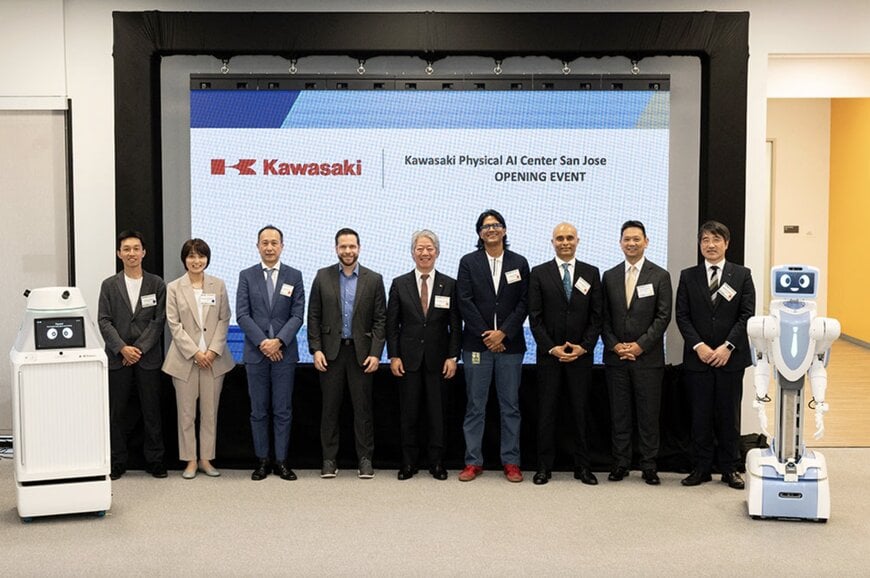
Kawasaki Heavy Industries is establishing a dedicated technology hub in San Jose to develop and deploy physical artificial intelligence solutions across global industrial sectors.
The cooperation addresses the operational challenge of implementing autonomous reasoning, perception, and real-world physical decision-making within manufacturing, mobility, and healthcare systems. By linking long-term operational telemetry from heavy manufacturing with advanced computing platforms, the participating entities aim to accelerate the transition from isolated digital models to integrated digital infrastructure. This multi-partner alignment is required because the social deployment of automated machinery relies on combining localized physical data with scalable cloud frameworks and complex sensing interfaces.
Technical solution and partner responsibilities
The collaborative architecture centers on integrating physical artificial intelligence (Physical AI) with established robotic platforms, including autonomous service robots, indoor delivery systems, surgical robotics, and multi-legged transport vehicles. Responsibility for system components is divided among the technology partners based on their core technical competencies:
- Kawasaki Heavy Industries provides the underlying mechanical platforms, operational telemetry, and manufacturing domain expertise.
- NVIDIA focuses on the integration of robotics computing architectures and AI modeling, using healthcare as an initial entry point.
- Analog Devices delivers advanced sensing and voice recognition technologies to enable robots to execute varied manual tasks.
- Microsoft supplies cloud computing capabilities and AI platforms to verify the structural reliability and scalability of real-world operations.
- Fujitsu integrates enterprise business systems with robotic controls to establish new workflows within the medical and care domains.
System functionality and network integration
The technical platform functions by processing real-world sensory inputs and translating them into physical actions via machine control loops. The systems use edge computing gateways alongside centralized cloud architectures to ensure high-fidelity data fusion. The integration process connects the robots' onboard control units to secure cloud networks, allowing for modular software updates and continuous pattern analysis without disrupting operations. Standardized communication interfaces are utilized to ensure that the voice, tactile, and optical data streams remain synchronized during dynamic tasks.
Applications and operational use cases
The primary application areas for these integrated solutions include the healthcare, nursing care, and mobility sectors. Concrete technical use cases focus on automated hospital logistics using indoor delivery robots and precise multi-axis movement orchestration within surgical environments. By implementing this integrated approach, facilities achieve higher process stability and maintainability. The technical reasoning for this deployment lies in the reduction of configuration bottlenecks; by utilizing pre-validated sensing and processing modules, the autonomous systems can adapt to real-time environmental changes, thereby improving operational safety and reducing manual supervision requirements.
Global deployment and expected results
The technical framework establishes a distributed development matrix linking the new Silicon Valley hub with domestic engineering bases in Japan and the European innovation center in Strasbourg, France, which began operations in March 2026. This layout ensures that localized market needs are integrated directly into the core software architectures. The resulting scalability allows for faster verification cycles when adapting autonomous models to diverse regional regulations. While individual output metrics depend on the specific deployment site, the architectural transition to high-fidelity Physical AI structures delivers a standardized pathway for stabilizing automated services in complex human environments.
Edited by Romila DSilva, Induportals Editor, with AI assistance.
The technical platform functions by processing real-world sensory inputs and translating them into physical actions via machine control loops. The systems use edge computing gateways alongside centralized cloud architectures to ensure high-fidelity data fusion. The integration process connects the robots' onboard control units to secure cloud networks, allowing for modular software updates and continuous pattern analysis without disrupting operations. Standardized communication interfaces are utilized to ensure that the voice, tactile, and optical data streams remain synchronized during dynamic tasks.
Applications and operational use cases
The primary application areas for these integrated solutions include the healthcare, nursing care, and mobility sectors. Concrete technical use cases focus on automated hospital logistics using indoor delivery robots and precise multi-axis movement orchestration within surgical environments. By implementing this integrated approach, facilities achieve higher process stability and maintainability. The technical reasoning for this deployment lies in the reduction of configuration bottlenecks; by utilizing pre-validated sensing and processing modules, the autonomous systems can adapt to real-time environmental changes, thereby improving operational safety and reducing manual supervision requirements.
Global deployment and expected results
The technical framework establishes a distributed development matrix linking the new Silicon Valley hub with domestic engineering bases in Japan and the European innovation center in Strasbourg, France, which began operations in March 2026. This layout ensures that localized market needs are integrated directly into the core software architectures. The resulting scalability allows for faster verification cycles when adapting autonomous models to diverse regional regulations. While individual output metrics depend on the specific deployment site, the architectural transition to high-fidelity Physical AI structures delivers a standardized pathway for stabilizing automated services in complex human environments.
Edited by Romila DSilva, Induportals Editor, with AI assistance.
-2296-71282-204124.png)