
www.magazine-industry-usa.com
02
'26
Written on Modified on
Private 5G Expansion Targets Industrial Connectivity
Siemens extends its industrial private 5G infrastructure to new markets, enabling deterministic wireless connectivity and edge-based data processing for manufacturing environments.
www.siemens.com
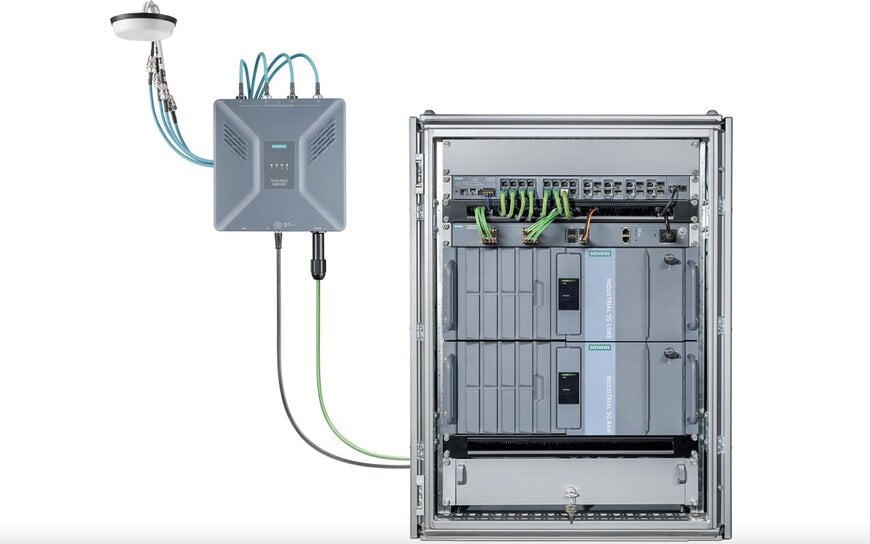
Siemens is expanding its private 5G infrastructure to additional countries across Europe and the Americas, supported by new radio units operating in the 3.8–4.2 GHz band and the U.S.-specific CBRS spectrum. The rollout increases availability to 15 countries and introduces localized deployment options for industrial users, including planned availability in the United States in 2026.
Licensed spectrum for deterministic industrial connectivity
Industrial environments are generating increasing volumes of data due to the adoption of AI-driven applications and connected devices. Conventional wireless technologies operating in unlicensed bands can experience interference and congestion, particularly in dense production settings.
Private 5G networks address these limitations by operating in licensed or shared spectrum, such as the CBRS band in the United States. This enables predictable latency, higher reliability, and controlled network performance for critical industrial applications.
Edge-enabled 5G infrastructure for real-time processing
The updated system includes enhanced 5G routers with integrated edge runtime capabilities. This allows applications to run directly on network devices, reducing the need for additional computing hardware.
By processing data at the network edge, the system supports real-time analytics and AI-driven decision-making on the shop floor. This is particularly relevant for time-sensitive applications such as machine control, quality inspection, and autonomous systems.
Integration with industrial automation systems
The infrastructure is designed for seamless integration into existing industrial environments. It supports industrial communication protocols such as PROFINET and enables flexible configuration of uplink and downlink capacities through adjustable time division duplex (TDD) patterns.
A web-based interface simplifies deployment and configuration, requiring a limited number of parameters. This allows implementation by operational personnel without extensive IT specialization.
Safety and cybersecurity considerations
The system has been certified to support wireless PROFIsafe communication, enabling its use in safety-related applications when combined with compatible automation equipment. This certification is critical for industries where functional safety requirements must be maintained in wireless communication environments.
The architecture also emphasizes operational technology (OT) cybersecurity, supporting secure, on-premises network operation without reliance on external telecom providers.
Deployment availability across regions
The infrastructure is being deployed in countries that provide spectrum for private 5G networks.
Newly added markets include Belgium, Canada, Finland, France, Norway, Poland, and the United Kingdom, with the United States scheduled for availability in summer 2026.
Existing deployments are already available in Austria, Brazil, Denmark, Germany, the Netherlands, Sweden, and Switzerland.
Edited by Romila DSilva, Induportals Editor, with AI assistance.
-2296-71282-204124.png)