
AI Platform for Scalable Industrial Automation Systems
KUKA introduces the Automation Management Platform (AMP) to standardize AI-driven automation across robots, mobile systems, and production environments.
www.kuka.com
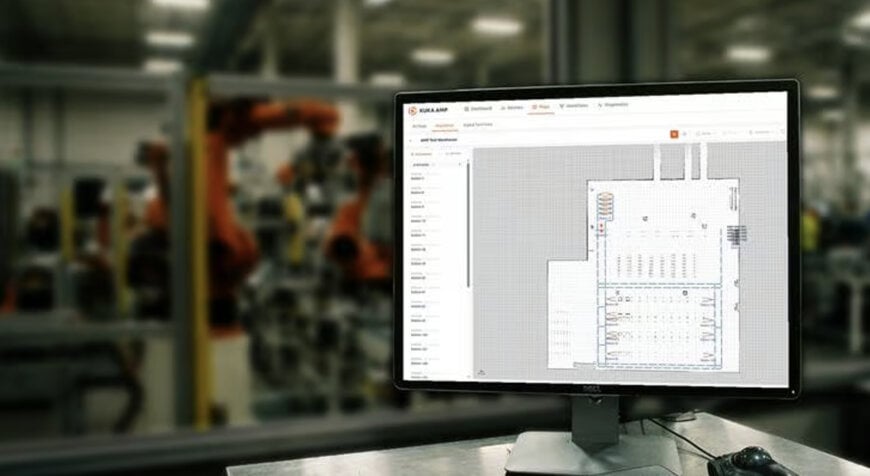
KUKA has launched the Automation Management Platform (AMP), a software-centric solution designed to unify industrial automation through artificial intelligence, standardized data models, and interoperable control layers. The platform targets applications across robotics, autonomous mobile robots (AMRs), and integrated work cells, enabling scalable deployment within a digital supply chain.
Bridging AI and industrial production environments
Industrial robots are optimized for repeatability, but adapting to changing production conditions often requires manual reconfiguration, specialized expertise, and fragmented toolchains. KUKA AMP addresses these limitations by introducing a structured framework for how AI systems interpret, decide, and execute actions in real-world environments.
The platform standardizes semantics, actions, and data across different assets, enabling consistent behavior across heterogeneous systems. This approach is intended to improve predictability, safety, and scalability in AI-driven automation, particularly in environments where variability and dynamic conditions are common.
Core architecture for Physical AI applications
At its core, KUKA AMP introduces a platform layer positioned between AI agents and physical hardware. This layer provides three functional components that translate high-level objectives into executable machine operations:
- Semantics define a shared context, allowing systems to interpret intent and map real-world conditions into machine-readable structures.
- Actions provide standardized control interfaces, enabling consistent execution across robots, AMRs, and production equipment.
- Data establishes a structured telemetry environment, capturing operational states and enabling continuous optimization through feedback loops.
Together, these components enable a closed-loop system in which operations are continuously observed, executed, evaluated, and refined.
Closed-loop optimization and digital twin integration
KUKA AMP operates through a continuous cycle of abstraction, monitoring, execution, and prediction. By linking real-world operations with digital representations, the platform supports optimization across both physical systems and their digital twins.
This feedback-driven model allows each task, process, and exception to contribute to system learning, improving performance over time. The result is a more adaptive automation environment capable of responding to changing production requirements without extensive reprogramming.
Open API platform for integrated automation ecosystems
The platform is designed as an open, modular API architecture that enables orchestration of diverse automation components within a single environment. This includes industrial robots, AMRs, work cells, software tools, and digital services.
A unified interface supports the full lifecycle of automation systems, from design and simulation to deployment, monitoring, and optimization. This “single pane of glass” approach reduces system complexity and improves visibility across operations.
Strategic role in next-generation automation
The introduction of KUKA AMP represents a transition from deterministic automation models toward AI-driven, intent-based systems. By combining established robotics hardware with software-defined capabilities, KUKA aims to expand automation into new application domains.
With a global installed base exceeding 550,000 robots and a strong presence in key markets such as China, the company is extending its portfolio through AI-enabled platforms that integrate orchestration, data processing, and digital services. The Automation Management Platform serves as a central layer in this strategy, supporting the evolution toward more flexible, intelligent, and connected industrial systems.
Edited by Maria Brueva, Induportals editor – adapted by AI.
www.kuka.com
-2296-71282-204124.png)