
www.magazine-industry-usa.com
19
'26
Written on Modified on
WIKA Expands Level Measurement with Compact Radar Sensor
Non-contact radar technology enables accurate level measurement in viscous, solid, and particle-laden media, including through plastic containers and in confined installations.
www.wika.com
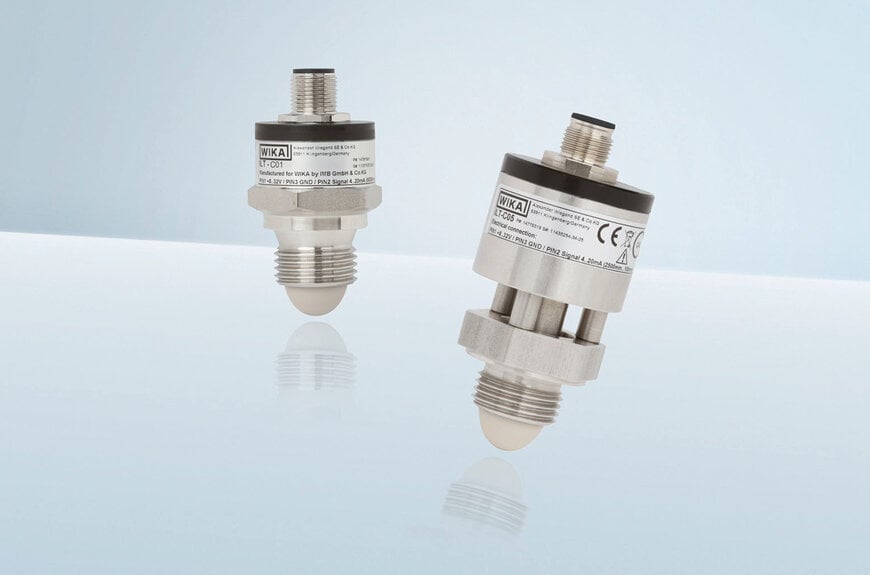
Level measurement in wastewater treatment, raw material storage, mobile machinery, and heating systems increasingly requires reliable sensing in confined spaces and with difficult media, leading WIKA to introduce the ILT radar sensor for continuous, non-contact level measurement under challenging conditions.
Unlike contact-based sensors, the ILT uses a free-beam radar principle that allows measurement without direct interaction with the medium. This enables operation even through plastic container walls, reducing installation complexity and eliminating contamination risks. Such an approach is particularly relevant in applications involving highly viscous fluids, bulk solids, or particle-containing media, where mechanical probes may suffer from buildup or wear.
Radar sensing enables measurement in difficult media
The ILT sensor applies radar-based level detection to maintain measurement stability across a wide range of materials, including fuels, raw materials, and wastewater. By avoiding direct contact, the sensor minimizes maintenance requirements and ensures long-term reliability in environments prone to fouling or abrasion.
This non-contact capability also supports consistent readings in processes where media properties vary, such as density fluctuations or the presence of suspended particles, which can affect traditional measurement technologies.
Designed for confined and harsh industrial environments
The compact design of the ILT enables installation in space-constrained systems, including mobile working machines and compact heating units. In such setups, sensor footprint and mounting flexibility are critical for integration without redesigning equipment layouts.
Two variants address different thermal requirements: the ILT-C01 operates within a temperature range of -40 °C to +100 °C, while the ILT-C05 extends operation up to 150 °C. This allows deployment across a broader range of industrial processes, including those involving elevated temperatures.
To maintain signal integrity, the sensor incorporates metal shielding that reduces interference from surrounding electrical fields. It is also engineered to operate reliably under dust, moisture, and heat exposure, while tolerating mechanical stresses such as vibrations and shocks up to 100 g. These characteristics make it suitable for dynamic environments, including mobile and industrial machinery.
Integrated switching functions for process control
In addition to continuous level measurement, the ILT can be configured with up to two switching points. These outputs enable functions such as overflow prevention or dry-run protection, supporting safer and more automated process control.
By combining measurement and switching capabilities in a single device, the sensor reduces the need for additional components, simplifying system design and wiring.
Position within non-contact level measurement technologies
Radar-based level sensors are commonly used in applications where ultrasonic or capacitive methods may be limited by environmental conditions or material properties. Compared to ultrasonic sensors, radar technology is less affected by temperature fluctuations, vapor, or dust.
The ILT expands WIKA’s portfolio by addressing applications requiring compact form factors, extended temperature resistance, and the ability to measure through non-metallic barriers. Customised versions are also available, allowing adaptation to specific industrial requirements.
Edited by Industrial Journalist, Natania Lyngdoh — Adapted by AI.
www.wika.com
