
Efficient textile recycling with AI and image processing
Intelligent sorting of old clothes.
en.ids-imaging.com
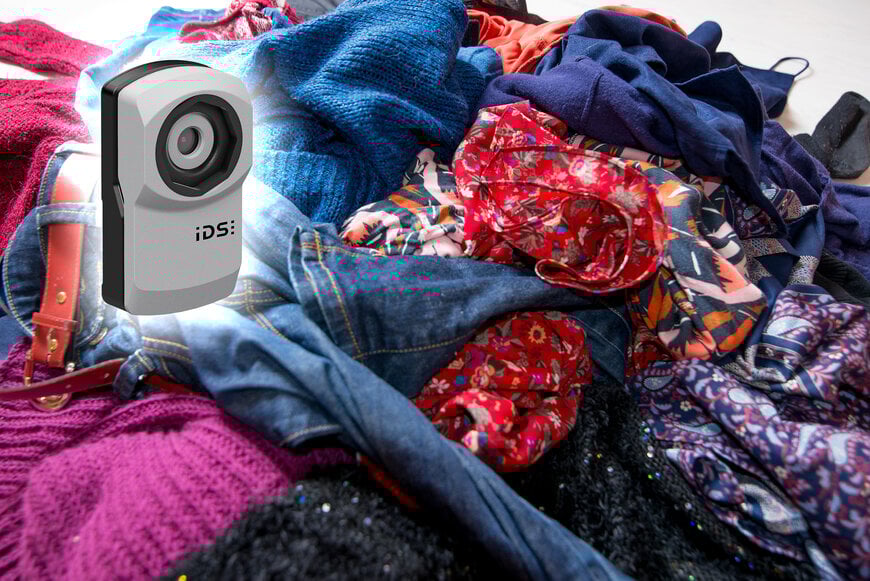
The mountain of old textiles continues to grow in Germany every year. Less than one per cent of this enters a closed recycling loop. Reasons for this include so-called "fast fashion", which leads to an increasing amount of low-quality textiles, as well as the wide variety of materials, which makes efficient recycling even more difficult. Today, sorting is mostly done manually and is almost impossible to manage given the quantities involved: Of around 1.4 million tons, only about 200,000 tons are actually checked and allocated. The rest is thermally recycled or exported abroad. Automated processes are therefore a key lever for keeping significantly more used textiles in circulation.
The Recycling Atelier at the Augsburg Institute for Textile Technology (ITA) is tackling this challenge. As a model factory, it maps the entire process of mechanical textile recycling. The focus is on a holistic concept that does not optimize individual sub-processes but rather takes the entire system into account. This approach led to the development of DETEX – an AI-based system for the automatic sorting of textiles. With the help of artificial intelligence and two high-resolution uEye XC cameras from IDS Imaging Development Systems GmbH, DETEX captures the essential features of the garments and assigns them precisely to specific categories. This makes sorting more accurate and lays the foundation for efficient recycling.
Why is sorting old clothes so important?
Before worn-out trousers, T-shirts or jumpers can be turned into something new, they must first be mechanically processed. The aim of this process is to create entirely new fabrics from the used garments. To achieve this, they are shredded, freed from buttons or zippers, and broken down into individual fibers. Preserving fiber length during this process is crucial to the quality of the recycled material produced. Differences in fabric structure and areal density must also be taken into account during processing. Precise classification into material categories is therefore essential and determines the subsequent handling of the textiles.
Until now, sorting has been done mainly by hand – a time-consuming process that requires a high level of expertise. In other industries, such tasks have long been performed by automated, AI-supported recognition systems. This is precisely where DETEX comes in: The research project is developing and testing AI models designed to make the sorting of used textiles significantly more efficient.
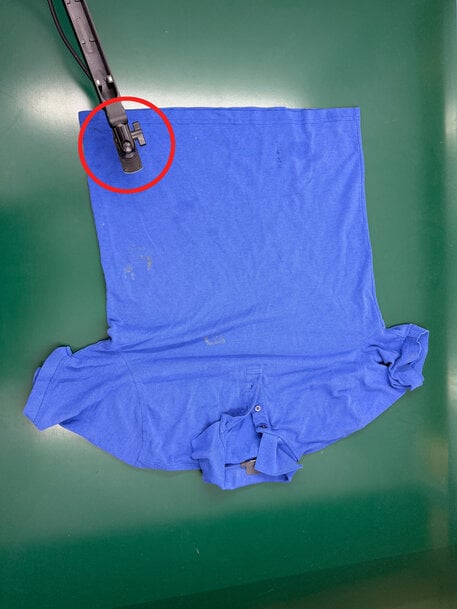
The AI uses a uEye XC camera to determine the type of material used in the textiles.
How does the system work?
DETEX relies on intelligent image processing to automatically recognize and classify textiles. Two high-resolution industrial cameras provide the necessary images by scanning garments as they move along a conveyor belt. Neural networks analyze the images and recognize patterns and structures based on previously learned data. To enable this, they were trained in advance using a large number of sample images, including photographs of various garments as well as close-up images of different fabric types. At least 3,000 samples per clothing category were required. This training data had to be manually categorized beforehand, for example by labelling an image of trousers as “trousers“. On this basis, DETEX can quickly and reliably assign new images to the appropriate textile categories.
For precise analysis, DETEX works with pre-trained neural networks – one model each for classification, object recognition and material identification. Different architectures and scenarios are being tested. This allows different degrees of difficulty and realism to be simulated in order to test how robust the AI models are against folds, overlaps or rotations.
Initially, an object detection model analyses the images captured by the first camera mounted above the conveyor belt. It determines the type of garment, such as a T-shirt, trousers or a dress. The second camera scans the garments again from a height of approximately 5 centimeters, focusing on material properties and the detection of features such as stains or buttons. The identified image sections are cropped and passed on to a second AI model, which classifies the type of material – specifically distinguishing between woven and knitted fabrics. Finally, the analysis results are clearly displayed on a screen.
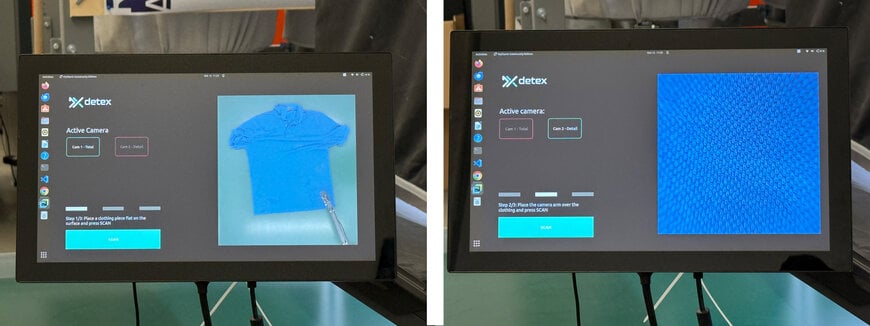
The analysis results are shown on a display.
Which cameras are used?
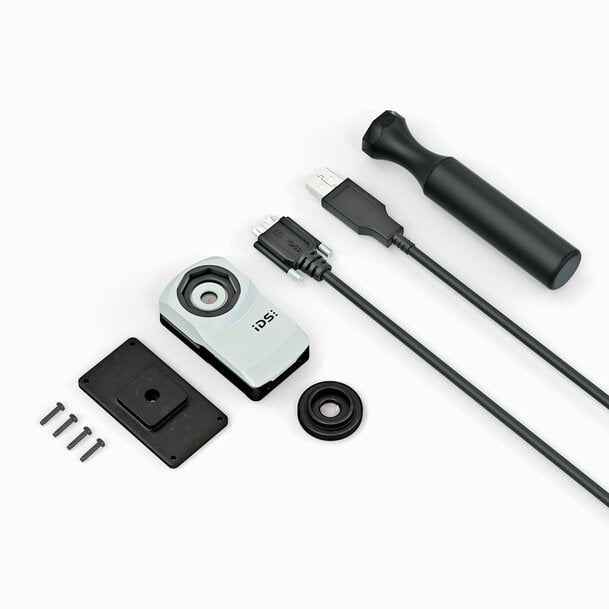
For image capture, the Augsburg-based institute relies on uEye XC cameras from IDS, specifically the uEye XC Starter Set. The complete package includes a camera, tripod, cables and a macro lens, providing a ready-to-use solution for the research project. Key factors in the camera selection were its compact design, 13-megapixel sensor and ease of use, as Martin Kohnle, Project Manager for AI & Digitalization at ITA, explains: “The uEye XC is as easy to use as a webcam, but has been specially developed for industrial applications. It delivers razor-sharp images even with varying object distances or challenging lighting conditions.” In addition, features such as a 24x digital zoom, auto white balance and automatic color correction ensure precise capture of even the finest details. As a genuine industrial camera, it was designed with long-term component availability in mind – an important advantage over conventional consumer webcams.
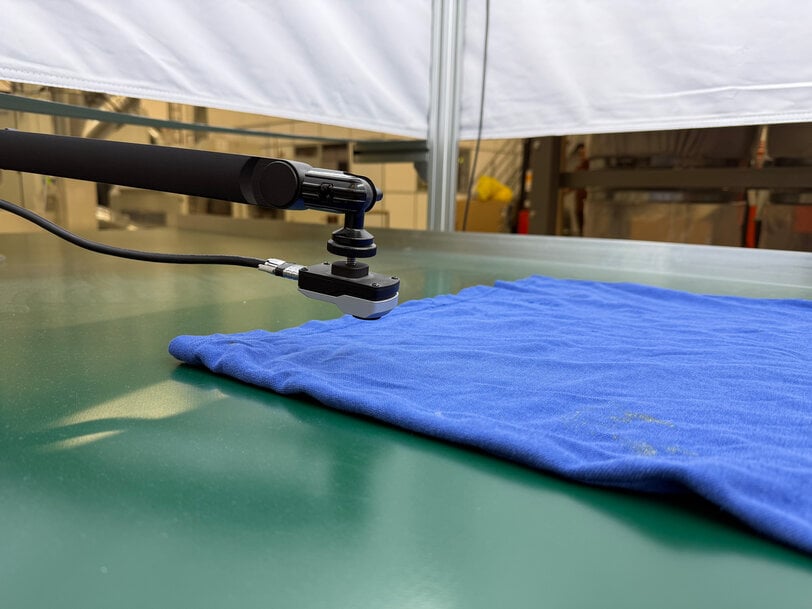
Thanks to the 24x digital zoom, auto white balance and automatic color correction, the camera captures every detail.
The Augsburg-based team relies on the free IDS peak camera software for image processing integration. The Software Development Kit (SDK) provides all necessary programming interfaces and tools for operating and controlling the cameras. “IDS peak enables straightforward and high-performance integration of our cameras via USB3 Vision. The uniform SDK structure greatly simplifies development, control and image acquisition. This enables us to implement our AI-based image processing workflows more quickly and adapt them flexibly”, Kohnle confirms.
What’s next?
The textile recycling market is increasingly moving towards data-driven, AI-based processes that require high-quality image data in real time. This increases the requirements for camera quality, synchronization and API compatibility for the recycling studio. Research focuses in particular on the flexible integration of various sensor technologies into adaptive sorting and analysis systems.
DETEX itself is also set to evolve: What is currently a conveyor-belt-based system will be expanded into a modular, mechanical-robotic overall solution that addresses both recycling and reuse. At its core will be a free-fall system enabling multi-perspective, 360° capture of textiles. In addition, a downstream, two-sided shot by robot-assisted grippers will allow for detailed analysis of further material characteristics. This approach makes it possible to capture a significantly broader range of information and to assign textiles even more precisely to suitable recycling or reuse pathways. Another important step towards a closed recycling loop – supported by industrial image processing.
Camera
uEye XC - Automatically perfect images
-2296-71282-204124.png)