
www.magazine-industry-usa.com
29
'26
Written on Modified on
400G Muxponder Deployment Enables Scalable 100G Enterprise Services
TOWARDEX deploys HUBER+SUHNER CUBOsystem 400G at the customer edge to scale high-capacity metro services in Boston.
www.hubersuhner.com
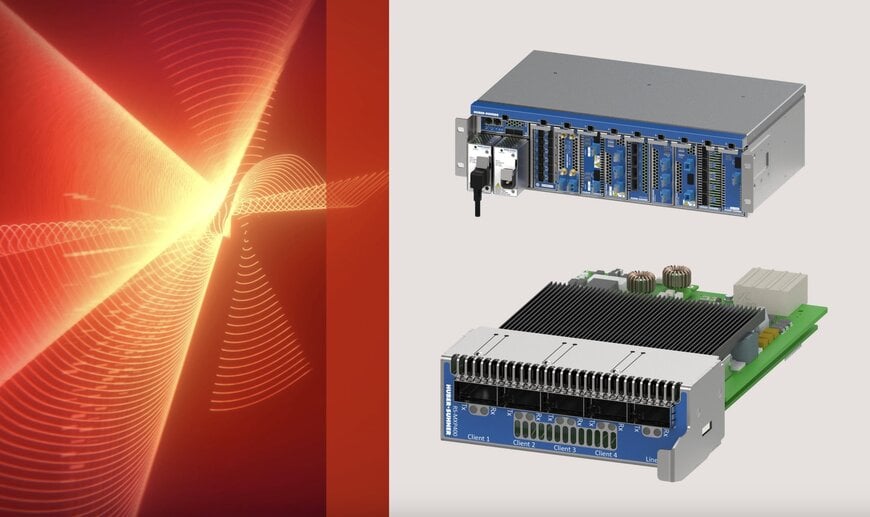
TOWARDEX has deployed the HUBER+SUHNER CUBOsystem 400G muxponder at the customer edge across the Boston area, enabling scalable delivery of 100G enterprise connectivity while preparing its metro network for future 800G and 1.6T optical transport.
Meeting rising demand for 100G enterprise connectivity
Demand for 100G enterprise connectivity is increasing across office campuses, customer premises, and multi-tenant facilities in Boston and the wider New England region. Traditional approaches to delivering 100G services at the customer edge have relied on architectures that are often space-intensive, power-hungry, and costly to scale, limiting their suitability for dense metro-edge deployments.
To address these constraints, TOWARDEX has introduced a customer-edge architecture based on the CUBOsystem 400G platform. The solution enables a single high-capacity 400G uplink to be terminated directly at customer locations and efficiently broken out into multiple 100G services, improving cost-per-bit and operational flexibility.
400G muxponding at the metro edge
The CUBOsystem 400G provides integrated muxponding and media conversion in a compact, carrier-grade form factor designed for edge environments. In the TOWARDEX deployment, the platform allows a 400G coherent optical interface to be extended from the metro network into customer demarcation points, where it can be subdivided into multiple client-side 100G circuits.
This approach reduces the need for multiple discrete devices at customer sites and simplifies service scaling as bandwidth requirements grow. By consolidating functionality at the edge, the architecture supports higher service density while minimizing power consumption and footprint.
Integration with existing metro infrastructure
TOWARDEX operates one of the most advanced regional networks in Massachusetts and is the organization behind the Massachusetts Internet Exchange (MASS IX). Any new edge technology therefore needs to integrate seamlessly with an existing ROADM-based metro architecture.
According to the operator, the CUBOsystem platform integrates cleanly with its current optical infrastructure, enabling straightforward service turn-up and expansion without major changes to the core or metro layers. This compatibility supports incremental scaling of customer services while preserving long-term network design consistency.
Preparing for higher-speed optical transport
Beyond immediate 100G service delivery, the deployment is positioned as a stepping stone toward higher-speed optical transport. The CUBOsystem 400G architecture is designed to support future transitions to 800G and 1.6T, allowing TOWARDEX to evolve its edge capabilities in line with advances in coherent optics.
This forward compatibility is particularly relevant for metro-edge environments, where equipment refresh cycles are closely tied to space, power, and operational constraints.
Carrier-grade design for distributed edge environments
The CUBOsystem product line is engineered for dense metro, access, and harsh-environment deployments, where reliability and compactness are critical. These characteristics align with TOWARDEX’s distributed edge model, which places high-performance optical equipment directly at customer demarcation locations rather than concentrating capacity solely in centralized facilities.
For enterprise and carrier customers, this translates into more direct access to high-capacity services and reduced latency between the metro network and end sites.
Application context
The Boston-area deployment illustrates how 400G muxponding at the customer edge can address growing enterprise bandwidth requirements while simplifying network operations. By combining high-capacity uplinks, efficient 100G service breakout, and compatibility with existing ROADM infrastructure, the approach offers a practical path for metro operators seeking to scale enterprise connectivity and prepare for next-generation optical transport.
www.hubersuhner.com
