
www.magazine-industry-usa.com
17
'25
Written on Modified on
Edge HMI platform targets industrial IoT deployments
SECO introduces an order-ready human–machine interface designed to shorten development cycles and support scalable edge computing across industrial and regulated environments.
www.secotools.com
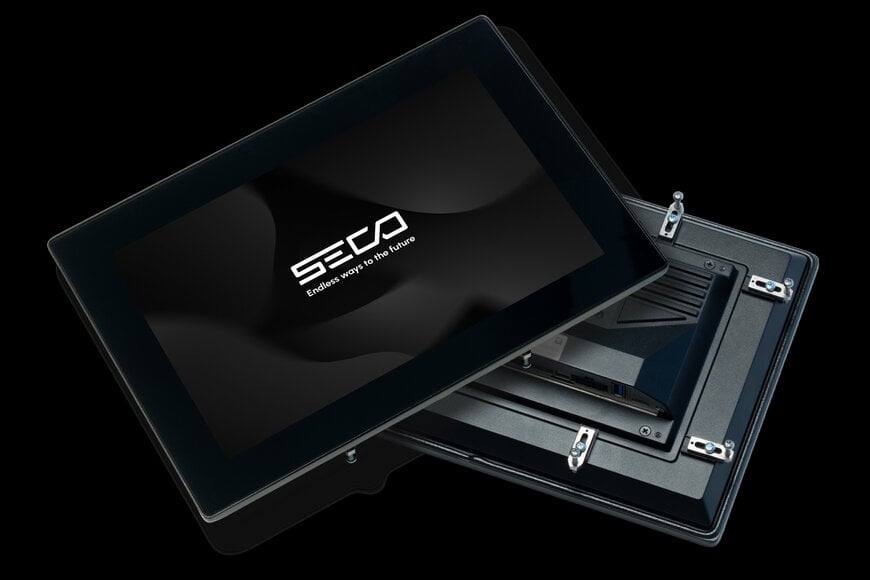
For industrial IoT and embedded edge computing applications, human–machine interfaces increasingly need to combine compute performance, long-term availability, and remote lifecycle management. SECO has released a modular HMI platform intended to help OEMs and system integrators deploy connected interfaces faster while maintaining flexibility across multiple industrial sectors.
An order-ready HMI built for edge computing
The Modular Vision 10.1 ASL was introduced as part of SECO’s next-generation Modular Vision portfolio, positioned as a turnkey HMI rather than a custom-built embedded system. The approach addresses a common constraint in industrial IoT projects: reducing engineering effort while retaining the ability to adapt hardware configurations over time.
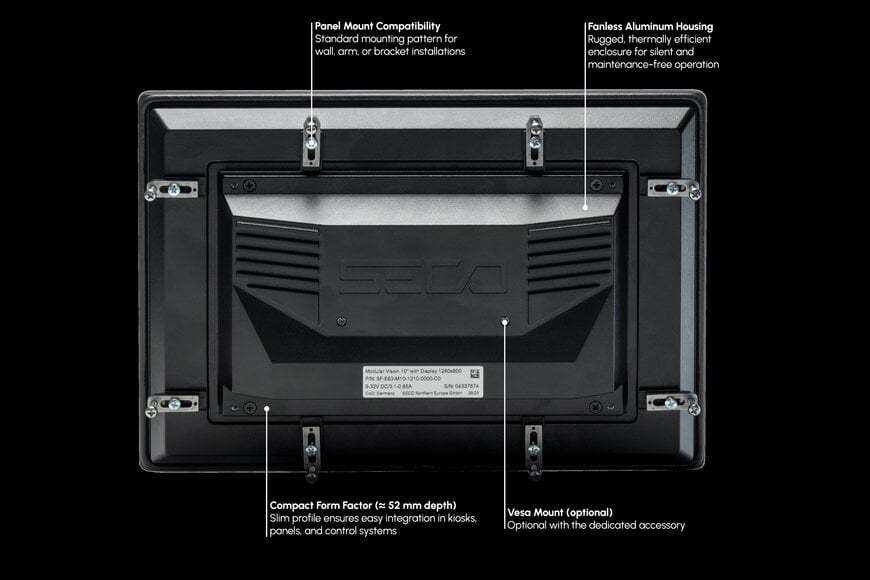
The platform integrates computing, graphics, and display into a single 10.1-inch unit, allowing it to be deployed directly in applications such as industrial automation, medical equipment, safety and surveillance systems, energy management, smart devices, and digital signage. Its modular architecture is designed to accommodate evolving performance requirements without a full redesign of the HMI hardware.
Processor architecture and real-time capabilities
At the hardware level, the HMI is based on Intel Atom x7000RE processors, a family designed for embedded and industrial use cases. The available configurations offer up to eight CPU cores operating at frequencies up to 3.6 GHz within a 12 W thermal design power envelope, balancing performance with energy efficiency. Integrated Intel UHD Graphics support local visualization workloads without the need for external GPUs.
The system supports up to 16 GB of LPDDR5 memory with in-band error correction (IBECC), a feature relevant for mission-critical environments where memory integrity affects system stability. For applications requiring deterministic behavior, such as robotics or motion control, the platform incorporates Time-Sensitive Networking (TSN) and Time-Coordinated Computing (TCC), enabling synchronized communication and predictable task execution across distributed systems.
Modular computing through SMARC system-on-modules
The HMI is built around SMARC-based system-on-modules, allowing users to select from four processor variants within the same mechanical and electrical platform. This modularity enables OEMs to scale performance or manage component availability over long product lifecycles, a key consideration in industrial and medical markets where devices may remain in service for many years.
By decoupling the compute module from the carrier and display assembly, the design supports upgrades or configuration changes without altering the entire HMI system, helping to manage both development cost and supply chain risk.
Software stack and device lifecycle management
On the software side, the Modular Vision series runs Clea OS, a Linux operating system based on the Yocto Project and tailored for industrial embedded devices. Clea OS integrates functions for remote device management, data processing, and standard industrial IoT communication protocols.
As part of the broader Clea framework, the operating system is designed to connect edge devices to cloud services and third-party platforms while supporting cybersecurity and regulatory compliance requirements. This enables centralized monitoring of device health, remote configuration, and software updates across installed fleets, reducing reliance on on-site maintenance interventions.
Edge AI and application deployment
To support application development and deployment, the HMI is compatible with the SECO Application Hub, a curated marketplace of applications optimized for edge devices. This environment provides access to pre-integrated AI and machine learning workloads that can run locally on the HMI hardware, supporting use cases such as image analysis, anomaly detection, or predictive maintenance without continuous cloud connectivity.
Relevance for industrial IoT projects
By combining an order-ready HMI design with modular compute options, real-time networking features, and integrated device management, the Modular Vision 10.1 ASL addresses several recurring challenges in industrial IoT and edge computing projects. The platform is positioned to support faster deployment, predictable system behavior, and long-term maintainability in applications where reliability, security, and scalability are primary technical requirements.
www.seco.com
-2296-71282-204124.png)