
www.magazine-industry-usa.com
09
'26
Written on Modified on
Is Manufacturing Ready for Net Zero?
Manufacturers will need to establish credible transition roadmaps, measure emissions accurately, and connect sustainability investments with business outcomes.
induportals-media-publishing.com
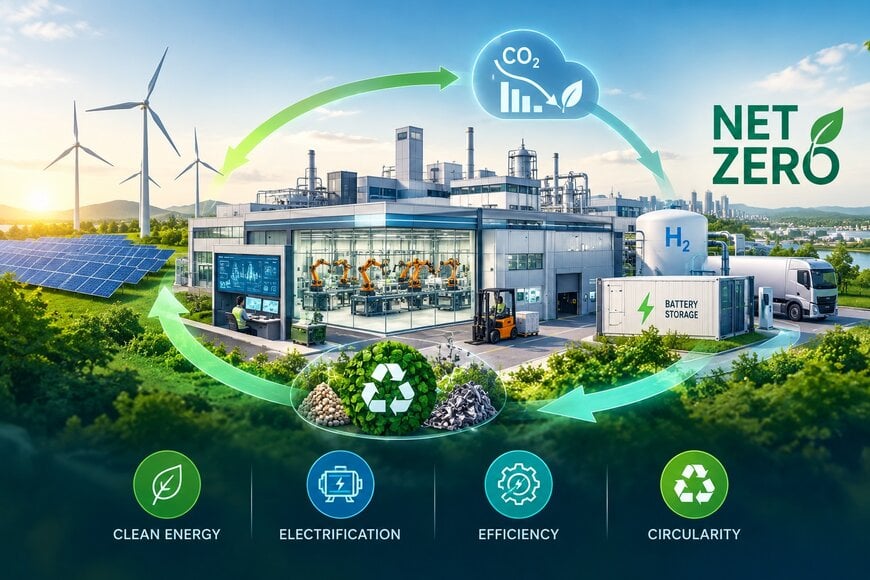
The global manufacturing sector is under growing pressure to reduce emissions, improve energy efficiency and move towards net-zero operations. But as ambitions become more aggressive, an important question remains: is the industry actually ready for the transition?
The answer is complicated. Manufacturers have access to more decarbonisation technologies than ever before, but technology availability alone does not guarantee a successful transition. The economics, regulatory framework, energy infrastructure, supply chains and availability of critical inputs will determine how quickly industry can move from net-zero commitments to measurable results.
The regulatory question
Net-zero ambitions have been strengthened by governments and regulators worldwide, with policies increasingly targeting industrial emissions, energy efficiency, renewable-energy adoption, carbon reporting and supply-chain sustainability. For example, in India, the country's broader net-zero-by-2070 commitment has been accompanied by initiatives around renewable energy, green hydrogen, energy efficiency and carbon markets.
Yet manufacturers need greater clarity and consistency. Long-term industrial investments require predictable regulations, clear emissions standards and incentives that make decarbonisation economically attractive. Regulation therefore needs to move beyond setting targets and create an environment in which companies can confidently invest in cleaner technologies.
What does the WEF say?
The World Economic Forum has consistently highlighted industry as central to the global transition towards net zero. Its work on industrial transformation points to the need for collaboration between governments, manufacturers, technology providers and financial institutions.
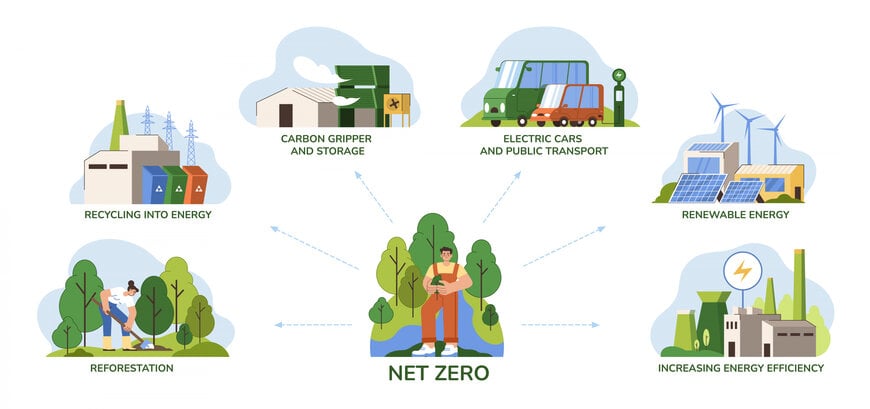
The challenge is particularly significant for hard-to-abate sectors such as steel, cement, chemicals and heavy manufacturing. Electrification, renewable energy, hydrogen, carbon management, circularity and improved energy efficiency will all have roles to play.
The WEF perspective also underlines an important reality: no individual company can achieve industrial decarbonisation in isolation. Manufacturing supply chains are interconnected, meaning progress depends on collaboration across entire industrial ecosystems.
Are the technology tools ready?
In many respects, yes.
Industrial automation, advanced drives, energy-efficient motors, digital energy management, AI, industrial IoT, predictive maintenance and digital twins are already helping manufacturers reduce energy consumption and optimise processes.
Electrification is another major opportunity. Replacing fossil-fuel-based processes with electrically powered alternatives can significantly reduce emissions where electricity comes increasingly from renewable sources. Renewable power, battery energy storage systems, smart grids and green hydrogen are also expanding the technology toolbox.
The bigger challenge is accessibility and scalability. Large multinational manufacturers may have the financial and technical resources to deploy advanced systems, while smaller manufacturers can struggle with capital costs, skills shortages and integration complexity.
The clean-energy supply-chain challenge
Net zero cannot happen without reliable access to clean energy. This makes the supply chain for solar modules, wind turbines, batteries, power electronics, electrolysers, critical minerals and grid infrastructure strategically important.
Energy storage is particularly critical. Renewable generation is variable, while industrial facilities often require continuous and predictable power. Battery energy storage, grid-scale storage and other emerging technologies will therefore become increasingly important.
This creates a new dependency: manufacturers seeking to decarbonise their operations will increasingly depend not only on their own technology investments but also on the resilience of the clean-energy ecosystem.
Is net zero economically viable?
This may ultimately be the most important question for manufacturers.
Decarbonisation requires capital expenditure, and many technologies still carry a premium compared with conventional alternatives. However, the economic equation is changing. Energy efficiency can directly reduce operating costs, while renewable power can provide greater protection against energy-price volatility.
There are also growing costs associated with not decarbonising. Carbon pricing, regulatory compliance, customer requirements, investor expectations and supply-chain pressures are increasingly influencing purchasing and investment decisions.
For manufacturers, therefore, net zero should not be viewed purely as a compliance exercise. It can become a competitiveness strategy—provided investments deliver measurable improvements in productivity, energy consumption and resource efficiency.
Who is leading the transition?
Several major industrial companies have already established ambitious net-zero programmes. Companies such as Siemens, Schneider Electric, ABB, Microsoft, Apple, Unilever, Danone, Volvo and IKEA have invested significantly in renewable energy, electrification, energy efficiency, circularity and emissions reduction across their operations and supply chains.
Siemens: Siemens has set a science-based target to achieve net zero across its value chain by 2050, with a 90% reduction in Scope 1 and 2 emissions and 30% reduction in Scope 3 by 2030. It is focusing heavily on energy efficiency, electrification, renewable-energy integration and digital technologies, while aiming to help customers avoid more than 1,000 Mt of CO₂e by 2030.
Schneider Electric: Schneider Electric is targeting net zero across its entire value chain by 2050, with a 76% reduction in Scope 1 and 2 emissions and 25% reduction in Scope 3 by 2030. Its strategy combines electrification, energy efficiency, renewable electricity, digital EcoStruxure solutions and supply-chain decarbonisation.
ABB: ABB has committed to net zero across its operations and upstream and downstream value chain by 2050, backed by SBTi-validated targets. Its approach centres on electrification, energy efficiency, renewable electricity, fleet electrification and helping customers reduce emissions through its automation and electrification technologies.
Microsoft: Microsoft aims to become carbon negative by 2030, reducing its emissions by more than half and removing more carbon than it emits; by 2050 it plans to remove an amount equivalent to its historical operational emissions since its founding. It is investing in renewable energy, energy-efficient data centres, carbon-removal technologies and supply-chain decarbonisation.
Apple: Apple’s Apple 2030 programme targets carbon neutrality across its entire footprint, including its supply chain and products, by 2030. The company is pursuing major reductions through renewable energy, lower-carbon materials, recycled content, product efficiency and cleaner transportation; it has already reported more than a 60% reduction in global GHG emissions from its 2015 baseline.
Unilever: Unilever aims for net-zero GHG emissions across its value chain by 2039 and zero emissions from its own operations by 2030. Its programme covers renewable electricity and heat, energy efficiency, sustainable raw materials, lower-carbon logistics, packaging innovation, regenerative agriculture and supplier decarbonisation.
Danone: Danone has committed to net zero by 2050, with near-term targets aligned with a 1.5°C pathway. Its transition plan focuses on renewable energy and efficiency, low-carbon dairy and methane reduction, sustainable agricultural sourcing, circular packaging and lower-carbon logistics.
Volvo Group: Volvo Group is targeting net-zero emissions across its value chain by 2040, ten years ahead of the conventional 2050 SBTi horizon. Its strategy is centred on electrification, battery-electric and hydrogen fuel-cell vehicles, sustainable fuels, energy efficiency and decarbonising its manufacturing and supply chain.
IKEA: IKEA has strengthened its climate strategy to target at least a 50% reduction in absolute value-chain GHG emissions by FY2030 and net zero by FY2050, covering Scopes 1, 2 and 3. It is pursuing renewable energy, circular materials, lower-emission products and supply chains, and carbon removal within its value chain rather than relying on offsets for its core reduction target
The experiences of these companies demonstrate that decarbonisation is not a single technology project. It requires an integrated approach spanning energy sourcing, manufacturing processes, automation, buildings, logistics, materials and supply chains.
From commitment to execution
So, is manufacturing ready for net zero?
The industry has many of the necessary tools. What remains uncertain is whether regulation, infrastructure, investment and supply chains can develop quickly enough to deploy them at the required scale.
The next phase will therefore be less about announcing net-zero ambitions and more about execution. Manufacturers will need to establish credible transition roadmaps, measure emissions accurately, prioritise the highest-impact interventions and connect sustainability investments with business outcomes.
Net zero will ultimately be won on the factory floor—not in corporate sustainability reports. The manufacturers best positioned for the future will be those that recognise decarbonisation not simply as an environmental obligation, but as an opportunity to build more efficient, resilient, intelligent and competitive industrial operations.
Article contributed by Milton D’Silva, a freelance technical writer, and former editor of Industrial Products Finder, India.
