
www.magazine-industry-usa.com
12
'26
Written on Modified on
Sustainable Aviation Fuels Driving the Race to Net Zero Skies
As aviation races toward net-zero by 2050, sustainable fuels and breakthrough propulsion technologies are redefining how the world stays connected.
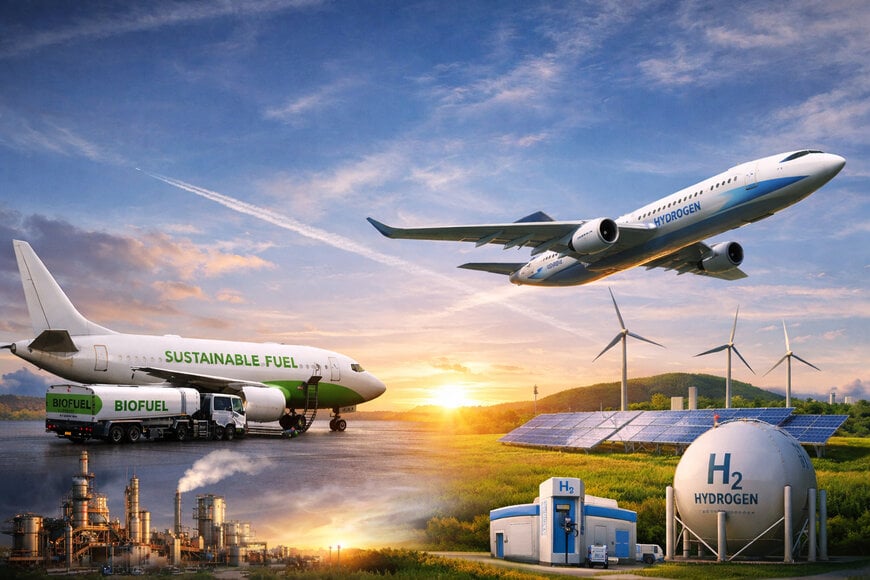
Aviation has always been about pushing boundaries—flying higher, farther, faster. Today, the industry faces a different kind of challenge: how to keep the world connected while dramatically cutting carbon emissions.
The pressure is real. Governments are tightening climate regulations. Investors are scrutinizing ESG performance. Passengers increasingly expect airlines to fly cleaner. And with global aviation targeting net-zero emissions by 2050, the runway for action is short.
At the center of this transformation is sustainable aviation fuel (SAF)—alongside emerging synthetic fuels and hydrogen propulsion systems that could reshape the future of flight.
A Market Moving at Record Speed
The numbers tell a powerful story.
Grand View Research estimates that the global sustainable aviation fuel market was worth US$1.04 billion in 2024 and could reach US$15.85 billion by 2030, growing at a CAGR of 57.5%. Credence Research projects even faster expansion, forecasting the market to surge from US$1.43 billion in 2024 to US$53.63 billion by 2032.
Growth rates above 50% are rare in heavy industries. In aviation fuel, they signal one thing: structural change.
This is no longer about pilot projects or symbolic test flights. SAF is moving into long-term procurement contracts, refinery expansions, and airport-level integration strategies.
Why SAF Is the Immediate Solution
Unlike electric vehicles, aircraft cannot rely on batteries—the weight simply makes it impractical for long-haul routes. Hydrogen aircraft are being developed, but widespread commercial deployment remains more than a decade away.
SAF, by contrast, works with today’s engines.
Certified SAF blends can be used in existing aircraft without major redesigns, cutting lifecycle carbon emissions by up to 80% depending on the feedstock and production pathway. That compatibility makes SAF aviation’s most practical near-term decarbonization tool.
Aircraft manufacturers such as Airbus and Boeing are already certifying fleets for higher SAF blend capability. At the same time, Airbus continues developing its ZEROe hydrogen aircraft concept targeted for service entry around 2035—showing that the industry is pursuing both immediate and long-term solutions in parallel.
For airlines under pressure to meet 2030 interim targets, SAF is not optional—it is operationally necessary.
Regulation Is Driving the Pace
One of the clearest signals that sustainable aviation fuel is here to stay is the way policy has evolved over the past few years. What began as voluntary targets and incentive schemes has increasingly shifted toward binding mandates and measurable compliance frameworks. Governments are no longer simply encouraging airlines to experiment with SAF—they are requiring its adoption as part of national and regional climate strategies.
Europe’s ReFuelEU Aviation initiative requires airlines to use a 2% SAF blend by 2025, increasing gradually to 70% by 2050. That regulatory clarity has unlocked billions in refinery investments.
North America currently holds the largest market share—around 45%—supported by clean fuel standards and federal incentives.
Asia Pacific is accelerating quickly. Singapore will mandate SAF usage for departing flights starting in 2026 at 1%, rising to 3–5% by 2030. Malaysia plans to begin SAF production in 2027 with an initial annual capacity of one million metric tons.
Meanwhile, Latin America is leveraging abundant biomass resources, particularly in Brazil, while the Middle East is aligning SAF development with broader energy diversification strategies. Airlines such as Emirates, Qatar Airways, and Etihad Airways are integrating SAF into long-term fuel planning.
Across regions, the message is consistent: decarbonization is now embedded in aviation policy.
Scaling Production: The Real Challenge
Demand is accelerating—but supply must keep pace.
Today, the dominant SAF pathway is HEFA (Hydroprocessed Esters and Fatty Acids), which converts waste oils and fats into jet fuel. It is commercially proven and widely available.
But HEFA alone will not be enough.
Other pathways—such as Fischer-Tropsch synthetic fuels, alcohol-to-jet conversion, and power-to-liquid (PtL) e-fuels—are gaining momentum. PtL fuels, produced using renewable electricity and captured CO₂, offer long-term scalability without relying on agricultural land.
Europe aims to reach roughly 7 million tons of SAF consumption annually by 2030, equivalent to around 10% of its aviation fuel demand. That target is ambitious but not unprecedented—Europe scaled biodiesel production to similar volumes within a decade when blending mandates were introduced for road transport.
The difference now is complexity. Aviation fuel standards are stricter, feedstock sustainability criteria are tighter, and infrastructure integration is more demanding.
Hydrogen: The Next Frontier
While sustainable aviation fuel is expected to carry much of the decarbonization burden over the next decade, hydrogen represents the industry’s most ambitious long-term frontier. Hydrogen-powered aircraft hold the promise of eliminating carbon emissions during flight, offering a fundamentally different propulsion pathway compared to today’s jet fuel systems. However, realizing that promise requires far more than a simple fuel substitution. It demands entirely new airframe architectures, advanced cryogenic storage technologies capable of safely handling liquid hydrogen at extremely low temperatures, and extensive upgrades to airport fueling infrastructure worldwide.
For these reasons, hydrogen is widely viewed as transformative—but not immediate. The industry’s transition is therefore likely to unfold in phases. Through the early to mid-2030s, sustainable aviation fuel will continue scaling rapidly as the primary near-term solution, leveraging compatibility with existing fleets and infrastructure. Beyond that point, hydrogen-powered aircraft are expected to gradually enter service, initially on short- to medium-haul routes where range and storage constraints are more manageable.
Importantly, hydrogen is unlikely to replace SAF outright. Instead, the two solutions are expected to coexist within a layered decarbonization strategy, with SAF addressing current fleet emissions while hydrogen defines the next generation of aircraft design. Together, they represent complementary pathways toward aviation’s long-term net-zero ambition rather than competing alternatives.
A Structural Shift, Not a Passing Trend
What makes this transition so significant is not just the rapid growth of the SAF market, but the fact that the entire aviation ecosystem is moving in the same direction. Governments are no longer simply encouraging cleaner fuels—they are embedding SAF requirements into binding policies and long-term climate frameworks. Airlines are signing multi-year supply agreements, not for public relations value, but to secure real volumes that help them meet measurable emissions targets. Aircraft manufacturers are ensuring fleet compatibility with higher SAF blends while continuing to invest in future propulsion technologies. At the same time, investors and energy companies are committing capital to expand refining capacity and accelerate commercialization.
This level of coordination signals something deeper than a trend. Sustainable aviation fuel has shifted from being an experimental sustainability initiative to becoming a central component of aviation strategy. It now sits inside boardroom discussions, capital expenditure plans, and long-term fleet strategies. Net-zero is no longer an abstract ambition framed for 2050—it is shaping operational decisions today.
The challenge ahead is not whether SAF works, but whether the industry can scale production quickly enough to meet rising demand. Expanding feedstock availability, building new production facilities, and integrating supply chains across regions will determine how smoothly aviation navigates this transition. As 2030 milestones draw nearer and long-term targets remain firmly in view, the future of aviation will be defined not only by new aircraft designs, but by the fuels that power them. The shift toward net-zero skies is already underway—and it is gathering momentum.
Article contributed by Kathryn Gerardino-Elagio, Editor-in-Chief, Ringier Trade Media, South East Asia.
