
www.magazine-industry-usa.com
09
'26
Written on Modified on
LTE Cat 1 Bis Development Board for European IoT
MIKROE introduces a new cellular add-on board providing reliable data transmission and low power consumption for utility meters, industrial sensors, and smart infrastructure.
www.mikroe.com
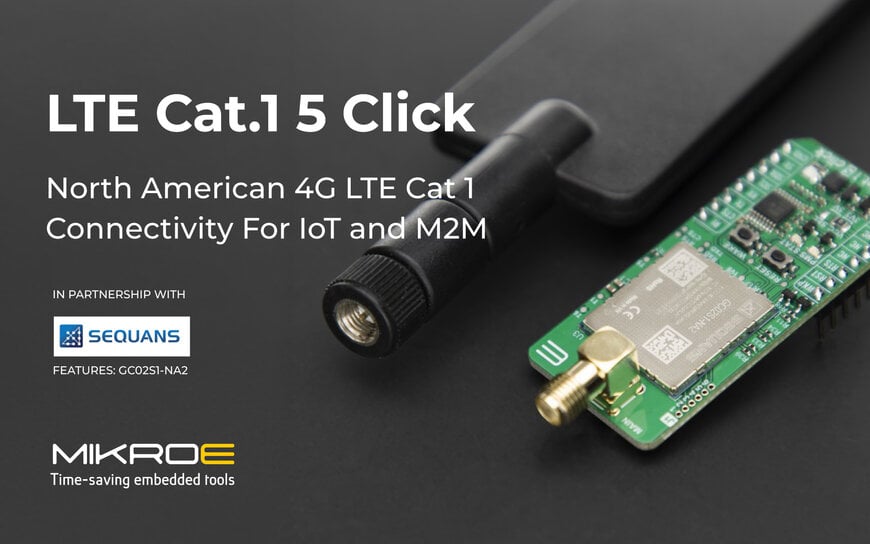
MIKROE has developed a cellular wireless connectivity add-on board engineered for European Internet of Things (IoT), machine-to-machine (M2M), and consumer applications. The system utilizes 4G LTE Cat 1 bis technology to support embedded hardware projects requiring consistent data transmission and constrained power consumption. The hardware allows developers to construct proof-of-concept models and operational prototypes for embedded infrastructure networks.
Module Specifications and Operating Frequencies
The board integrates the GC02S1-EU2 module, which complies with the 3GPP LTE Release 14 Cat 1 bis standard. This module features Calliope 2 silicon, developed by Sequans, designed to optimize processing performance while minimizing power usage. Engineered specifically for the European frequency spectrum, the hardware operates on LTE bands B1, B3, B8, B20, and B28, covering frequencies from 703MHz to 2170MHz. The data transmission capabilities include downlink speeds of up to 10Mbps and uplink speeds of up to 5Mbps.
System Interfaces and Host Integration
System communication routes through a UART interface, accompanied by support for hardware flow control and firmware upgrades. The board incorporates dedicated wake and reset functions, alongside debug access via UART1 and JTAG. It also accommodates a 1.8V uSIM card for network authentication. To streamline host integration, the board features a ClickID function, facilitating automatic host system identification. It interfaces with host architectures via the mikroBUS standard and utilizes open-source mikroSDK libraries for software development and configuration.
Industrial and Commercial Deployment Areas
The hardware addresses telemetry and integration requirements across multiple industrial sectors. Nebojsa Matic, CEO of MIKROE, indicates that the board is engineered for integration into utility meters, industrial sensors, security and alarm systems, payment terminals, asset trackers, smart home devices, smart metering infrastructure, and wearable consumer electronics.
Additional Context: Technical Specifications and Competitive Benchmarking
The adoption of LTE Cat 1 bis technology, initially introduced in 3GPP Release 13 and refined in Release 14, provides an architectural alternative to traditional LTE Cat 1 and Low Power Wide Area Network (LPWAN) standards such as NB-IoT and LTE-M. Standard LTE Cat 1 requires two receive antennas to achieve spatial diversity, whereas Cat 1 bis operates using a single antenna. This specification reduces the hardware footprint and internal component costs, effectively bridging the gap between high-throughput cellular modules and low-bandwidth IoT networks. In competitive benchmarking, LTE Cat 1 bis modules such as the Sequans Calliope 2 provide data rates of up to 10Mbps, significantly exceeding the 127kbps downlink limit of NB-IoT. Furthermore, LTE Cat 1 bis maintains continuous mobility support across cellular network towers. This characteristic makes Cat 1 bis applicable for mobile industrial use cases such as fleet asset tracking and portable payment terminals, whereas NB-IoT remains restricted primarily to stationary sensor applications.
Edited by an industrial journalist, Lekshman Ramdas, with AI assistance.
www.mikroe.com
